Consciousness—A Rainbow Over the Abyss: How the Unconscious Shapes Personal History
Psychologists have been discussing the power of the unconscious for over a century, yet there is still no serious experimental evidence for the existence of this layer of the psyche. I’d like to tell you about a recent study whose authors, Professor of Psychology David Oakley and Professor of Neuropsychology Peter Halligan, conducted a series of experiments using fMRI and concluded that consciousness not only fails to control emotions, feelings, and thoughts, but—on the contrary—is driven by them and retroactively creates explanations for these feelings and thoughts, thereby shaping our personal narrative. This sheds new light on how the conscious and the unconscious might interact with one another.
We often assume that our behavior, beliefs, or opinions about anything are the result of careful deliberation. It seems to us that there is a sort of “executive committee” sitting inside our heads that thinks, makes plans, reaches conclusions, and hands down ready-made decisions that we then put into action. This “top-down” model of executive control prevailed in people’s minds for decades and satisfied not only the general public but also scientists.
Today, most experts view human consciousness as a combination of two distinct phenomena. The first is personal consciousness, which we experience from one moment to the next and which serves as the source of our knowledge about who we are in the real world and where we are. It helps us recognize phenomena of objective reality and allows us to see opportunities and threats. The second is the content of consciousness: our thoughts, feelings, impressions, intentions, and memories.
In the article “Chasing the Rainbow: The Unconscious Nature of Being,” published in November 2017 in Frontiers of Psychology, a “revolutionary” claim is made that, in fact, our thoughts and feelings are not the result of conventional logic but are derived from rapid unconscious processes, and that “consciousness” does not imply an executive, causal, or controlling connection to any of the psychological processes we are familiar with, which are usually attributed to it. The researchers note that the experience of consciousness is a passive accompaniment to the unconscious processes of “internal broadcasting” and the creation of a personal narrative.
Simply put, we do not consciously choose our thoughts or feelings—we merely become aware of them and weave them into our own story.
Psychoanalysts, drawing on their clinical experience, have been talking about this for a century, but the use of magnetic resonance imaging (MRI) of the brain during hypnosis sessions has provided several more arguments in favor of the primacy of our brain’s unconscious mechanisms in shaping human personality.
The study was organized by David Oakley, professor emeritus of psychology at University College London, and Peter Halligan, professor of neuropsychology at Cardiff University in Wales. They used a method of hypnotic induction, which had been applied to treat neuropsychological and neuropsychiatric disorders, and simultaneously recorded the brain activity of the subjects to track the presence of signals between the brain and the body.
The experiments revealed a pattern showing that in highly suggestible states, people can change their beliefs, mood, and perceptions. For example, study participants raised their hands even when their brains did not receive a conscious signal to do so—an action that appeared unintentional—and the researchers were able to convince the participants that aliens were forcing them to do so.
In one experiment, researchers recorded participants’ brain activity in three situations: when they raised their hand intentionally, when it was raised by a lever, and when it moved in response to a hypnotic suggestion that a lever was raising it. The same brain regions were active during involuntary and supposedly “external” movements, whereas brain activity for intentional actions was different. Thus, hypnotic suggestion can be viewed as a means of conveying an idea or belief that, once accepted, can alter a person’s perception or behavior.
The Conversation
Scientists have concluded that our brain is designed less for generating inferences and conclusions and more for recognizing what we feel. The authors of the article note that the “content of consciousness” does not arise entirely from “conscious experience,” but originates in “unconscious brain activity.”
The rainbow metaphor illustrates this point well:
Individual consciousness is like a rainbow that accompanies physical processes in the atmosphere but has no effect on them.
The English biologist and science popularizer Thomas Henry Huxley compared the conscious part of the psyche to something like a train’s steam whistle, which accompanies the engine’s operation but has no internal influence over or control of it (Huxley, 1874).
Thus, personal consciousness is real; it coexists with the unconscious processes of our brain’s (or psyche’s) vital functions, but it is not a cause and exerts no influence on our psychological processes.
The authors write that unconscious activity generates virtually all the content of our consciousness through a mechanism known as continuous self-referential narrationSelf-reference is a phenomenon that occurs in systems of statements when a given concept refers to itself.. Behind the scenes of conscious activity, our thoughts, feelings, and emotions regarding a particular experience interact quite rapidly and very effectively, conserving our conscious resources—which is essential for our survival.
What, exactly, is a continuous “self-referential individual narrative”? According to the authors, it is the sum of accumulated experience and the impressions that experience once evoked.
This “database” is not static; it is constantly updated as new life experiences influence us. It is more of a process, fluid and ever-changing in nature, which is why it is better to refer to it as a narrative. Thanks to this process, we can communicate with others, understand them, build closer relationships, and collaborate for the common good.
In light of the above, a question arises: to what extent are we responsible for our behavior, and to what extent is it beyond the control of our consciousness?
Given that most of our thoughts and feelings are beyond our control, can we be fully responsible for the choices we make, our opinions, beliefs, or behavior? And if we are not fully responsible for them, who shares this responsibility with us?
In their interview with The Conversation, the researchers state that they view “free will and personal responsibility as ideas instilled in us by the social order.”
These ideas merely reflect the conventional wisdom about how things work, but they can contribute to a misunderstanding of how and why we behave in certain ways and the path our society is taking.
On the other hand, this instillation of the idea of free will helps us speak of ourselves as individuals, convey our narrative to others, enrich our experiences, and form closer bonds, thereby fostering social cooperation and evolution.
Translated by psychotherapist S.V. Belukhina. Read more…
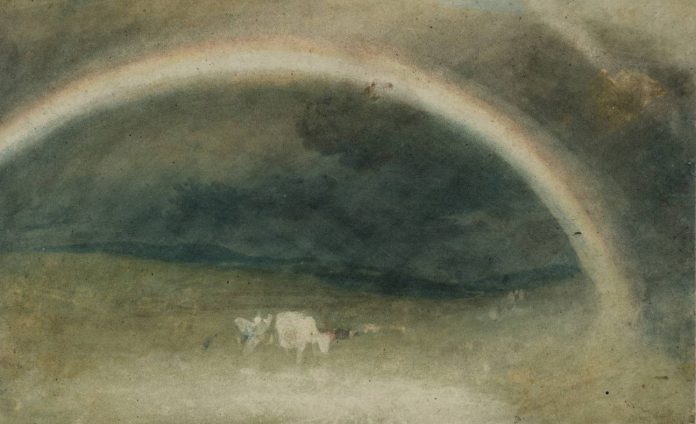
Cover: Joseph Mallord William Turner, A Rainbow, with Cattle (1815)
First published in “Monocle” on May 14, 2018