Being Online: What Does It Mean for Psychoanalysis?
An article by Antonino Ferro, included in the book “Psychoanalysis and Life in the Age of the COVID Pandemic: Common Distress, Individual Experience” / Psychoanalysis and Covidian Life: Common Distress, Individual Experience, 2020.
Antonino Ferro is the former president of the Italian Psychoanalytic Society (SPI), a post-Bionian psychoanalyst and training analyst, a supervisor (IPA), and recipient of the Maria Sigurni Award for outstanding contributions to psychoanalysis (2007). He practices in Pavia, Italy.
Introduction
I do not think it is appropriate to compare remote psychoanalytic work with the traditional setting while we are still in the midst of an ongoing pandemicThis article was written in August 2020. Instead, I believe it is necessary to discuss whether some aspects of this experience can be incorporated into our practice once we return to normal life.
Will online analysis become an alternative to in-person therapy? Will we benefit from this forced situation? Will we develop new methods, refine our skills, and begin to apply them in psychoanalytic practice and in everyday life?
***
I would like to note that remote work has always provoked particularly strong objections within the psychoanalytic community. It has been used sparingly, out of concern that it might distort the true nature of the analytic process.
It was believed that if a person is not physically present in the psychoanalytic office, this facilitates the release of emotions that are difficult to manage, may lead to avoiding the experience of certain feelings, and generally hinders the ability to think through thoughts that are “waiting for their thinker.”
Nevertheless, online psychoanalysis was already being used in certain circumstances even before the lockdown. This primarily concerned a less controversial activity: conducting supervision sessions. It was also indicated in cases where geographical distance or specific confidentiality needs made it impossible for the patient to be physically present in the analyst’s office.
***
At the height of the first lockdown in Italy, two online seminars were held—one by a novice practitioner and the other by an experienced, highly qualified training analyst. Both speakers were strongly opposed to remote work, as they had observed a loss of emotional contact with their patients.
Of course, any changes in psychoanalysis have always been difficult to implement: one need only recall the famous “Controversial Discussion” of 1943–1944. But it is also true that in recent years, psychoanalysis has significantly expanded beyond its original boundaries, particularly with regard to working with young children, the elderly, and seriously ill patients. It is precisely in these areas that online practice has developed.
I believe that the changes in our work brought about by COVID-19 marked the true birth—and subsequent acceptance by the professional community—of remote work. I would call this nothing less than a revolution, one that initially led to heated debates and discussions but then forced us to take a fresh look at our established beliefs.
What I’m about to share below is not dogma; it’s simply what I’ve experienced with my patients while working remotely.
Flexibility and Invariance: Negative Capacity and Play
The first significant change I unexpectedly discovered was a sense of greater freedom in using “negative capability”—or, in Keats’s words, the ability “to abide in uncertainty, mystery, and doubt, without the urge to immediately reach conclusions and draw conclusions” (1817, p. 277).
I also felt that communication within the analytic field had become softer and more fluid. I was more often able to stay “on track” in every sense, which, in my opinion, is linked to the expansion of the dimension of play.
It should be noted that the setting in remote work requires more improvisation from participants, whereas its traditional variant retains the significance and characteristics of a strict institutional dimension.
As an analyst, I feel freer and work better when I’m not so heavily burdened by institutions, and that’s why I’ll definitely carry over the playful dimension and freedom to improvise into my in-person work.
Many of my colleagues have noted that during the lockdown, the computer screen felt like a filter that blocked emotions. My experience does not confirm this. On the contrary, I observed that emotions flowed quite freely.
Think about it: is theater necessarily a more immersive and emotionally impactful art form than film?
While working online, I was also delighted to notice how much richer verbal interaction has become in the online space. And I believe this is of fundamental importance because it opens a direct path for us to the realm of dreams.
After all, everything that is real to us is merely a portal to the imaginary, the dreamlike, and the transformative—a path to transforming concrete sensory experiences and concrete narratives into a “waking dream.” After all, our reality differs greatly from that realm which, from the very beginning, is conceived as oneiric and as play.
The dimension of play allows for the possibility of transformation even in a state of pleasure, whereas traditional psychoanalysis considers suffering to be an essential condition for change.
I think it is appropriate here to refer to Ogden (2019), who speaks of epistemological and ontological psychoanalysis, where the former relates to knowledge and understanding, and the latter to being and becoming. The oneiric dimension develops the capacity to dream, which the analyst and patient can and should bring to their collaborative work.
In the television series The Bridge, set in a city on the border between Mexico and the United States, there are two main characters—a fiercely emotional Mexican police officer and an American detective with Asperger’s syndrome. So, I believe that an analyst—and, consequently, his patient—must be able to oscillate in analytical work between extreme emotional involvement and autistic withdrawal. I believe that remote and in-person work represent two such levels at which minds can meet during a session, and that the constant shifting between them is precisely what guarantees a dynamic constructivist approach.
An exploration of play as a necessary space for development can be found in the work of D. Grotstein (2007). Therefore, I am certain that today he would first point out to us with a laugh (and then find a serious explanation for it) the fact that if a computer is already present in the mental setting, then perhaps there is already not only an alpha function there, but also the so-called alpha-d (remote) function, to which is delegated the ability to “alphabetize” all that sensory experience resulting from interaction with the new participants in the remote work setting—the screen, computer, keyboard, Wi-Fi connection, and so on.
***
It’s no secret that one of the most obvious characteristics of psychoanalysis today is its tendency to become somewhat rigid, which has slowed the field’s evolution. We like to stick to familiar paths, and when something new emerges, we feel a tremendous resistance.
Many analysts consider the classical setting, as proposed by Freud himself, to be the most productive. As for theory, we can observe varying degrees of openness to new ideas in different parts of the world, as evidenced by new vertices and approaches, such as the Kleinian and Bionian paradigms, as well as Bionian field theory.
Today, I observe how this new setting has gradually come to be accepted by both analysts and patients, which signifies not only an increase in their ability to adapt to significant changes but also their willingness to continue mourning the loss of their old, familiar way of life.
Let’s not forget that a change in circumstances doesn’t just mean loss. It also means gain. For example, many patients gratefully noted that online therapy freed up a few hours in their weekly schedule that they had previously spent commuting to see their analyst.
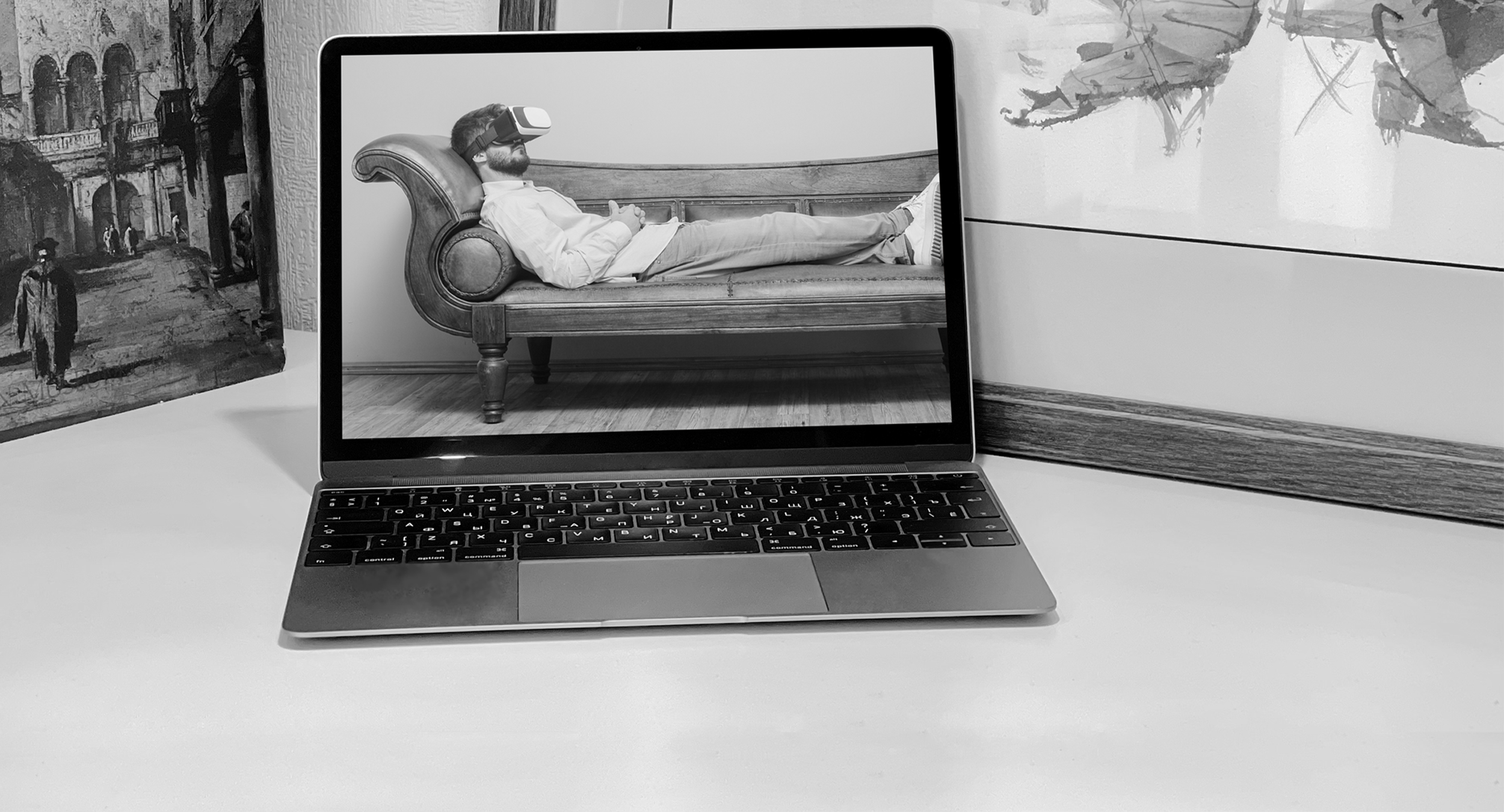
I readily offered my patients online sessions and agreed whenever they requested them. Without any prompting on my part, almost all of them set up a couch at home and placed a computer on a side table next to it so that I could see them. We saw each other’s faces at the beginning of the session and ended the call face-to-face as well. Only a couple of patients were unable to overcome the sense of disorientation caused by the new setting and switched to face-to-face sessions in front of a computer. There was a tacit understanding between us that as soon as the pandemic was under control, we would resume sessions in my office as before.
Conclusions
It seems to me that the forced shift to remote work—in a setting where we had previously relied exclusively on an in-person format—has completely changed the way we view analysis. Thanks to this sudden upheaval, we’ve now caught up with the modern world, and instead of continuing down the same path with only minor deviations—as we’ve done for the past 100 years—we’ve suddenly set out to explore something truly unknown.
Now, with remote analysis, the setting becomes more of an imaginary place (Vallino, 1999), and field theory is very helpful to us in this regard. Moreover, it seems to me that remote analysis also teaches us that we must become skilled at managing catastrophes, for nothing permanent can now be taken for granted.
The soothing repetitiveness of the setting, in which the agglutinated core begins to unravel (Bleger, 1967, p. 47), has been called into question, and I believe that this cataclysm will help us be better prepared for the emergence of repressed “thoughts that were impossible to conceive.” From this sudden disruption of the routine process, something new will undoubtedly emerge—something we have not yet encountered, something we were afraid to speak of.
I’d like to share an interesting example with you. The late Sicilian writer Andrea Camilleri, whose work is in some ways similar to that of Pirandello, went completely blind in the final years of his life, after writing the successful “Montalbano” series of novels. After losing his sight, he said that when he got close to someone, he had a kind of vision of that person’s psychological characteristics. His statement intrigued me. I thought that, as a novelist with a penchant for creating stories, narratives, and characters, he was certainly able to compensate for his lack of physical sight with an imaginative vision that revealed even those aspects of how other minds functioned that were invisible to the eye. In other words, Camilleri had a constructivist approach to other people’s minds, and oneiric vision had replaced his actual sight. Camilleri’s blindness can be viewed as a kind of extreme form of lockdown, within which he developed other forms of understanding.
Similarly, observing my patients, I have noticed that the loss of certain aspects of their normal lives has led to the development of other creative states of mind. And in my reflections on remote analysis, I should probably take into account that they experienced a real nightmare: the pandemic (Jarvis, 2020).
When thinking about our ability to adapt to change, I am also reminded of Craig Gillespie’s film Lars and the Real Girl. The main character in this film had never been in a relationship with a girl, something his entire family constantly reproached him for. One day, after his family had invited him to dinner for the thousandth time—telling him to bring a girlfriend if he had one—he showed up arm-in-arm with a very lifelike doll. The family acts as if nothing has happened, but the next day they complain about it to a psychiatrist. The psychiatrist advises them to continue behaving completely normally toward Lars and his doll. Over time, it becomes apparent that the doll has phobias regarding various foods and a number of traits that make her seem more and more human in everyone’s eyes. And after a while, the giant doll becomes part of the family unit. This shows that even the strangest things can be normalized if viewed without prejudice.
The same can be said about remote analysis. And we’ve seen something similar happen in many people’s daily lives with regard to mask-wearing. What was once considered strange eventually becomes so normal that now, on the contrary, people look askance at those who don’t wear a mask. Habit creates normality.
Lars’s girlfriend becomes more human, and we don’t know if this is because he’s developing a tendency toward interpersonal contact or because no one pays attention to the difference anymore.
The same thing happens when a setting becomes more of a playground for the mind: what was initially strange becomes familiar and routine. For some people, the transition from an old setting to a new one can be somewhat like moving to a new home. At first, they may feel uncomfortable and disoriented, but it’s amazing how little time it sometimes takes us to get used to something new.
After all, replacing primary objects with transitional ones is an important evolutionary step in any child’s life. The ability to experience grief and create new safe havens is a process of growing up that allows a person to adapt to new situations.
We’re all familiar with Kafka’s novel The Metamorphosis, which tells the story of a man’s sudden transformation into a cockroach, but we’re not yet sufficiently familiar with what Ian McEwan (2019) tells us about the transformation of a cockroach into a human.
In which direction do you think things will go, becoming “stranger and stranger”? Toward the already known or the as yet unknown?
Translated from Italian to English by Gillian Jarvis, and into Russian by Svetlana Belukhina.
Sources:
Bleger, J. (1967). Symbiosis and Ambiguity: A Psychoanalytical Study. Hove, UK: Routledge, 2013.
Grotstein, J. S. (2007). A Beam of Intense Darkness: Wilfred Bion’s Legacy to Psychoanalysis. London: Karnac.
Jarvis, G. (2020). Personal correspondence.
Keats, J. (1817). Letters. Edited by M. B. Forman. Oxford: Oxford University Press, 1952.
McEwan, I. (2019). The Cockroach. London: Vintage.
Ogden, T. H. (2019). Ontological psychoanalysis or “what do you want to be when you grow up?” Psychoanalytic Quarterly, 88(4): 661–684.
Vallino, D. (1999). Stories and the Imaginary Place in Child Psychoanalysis. In: A. Ferruta, R. Goisis, R. Jaffé, & N. Loiacono (Eds.), The Contribution of Psychoanalysis to the Treatment of Severe Disorders in Childhood and Adolescence (pp. 48–62). Rome: Armando Editore.
Republishing is welcome provided the authorship and source (headology.org) are cited.