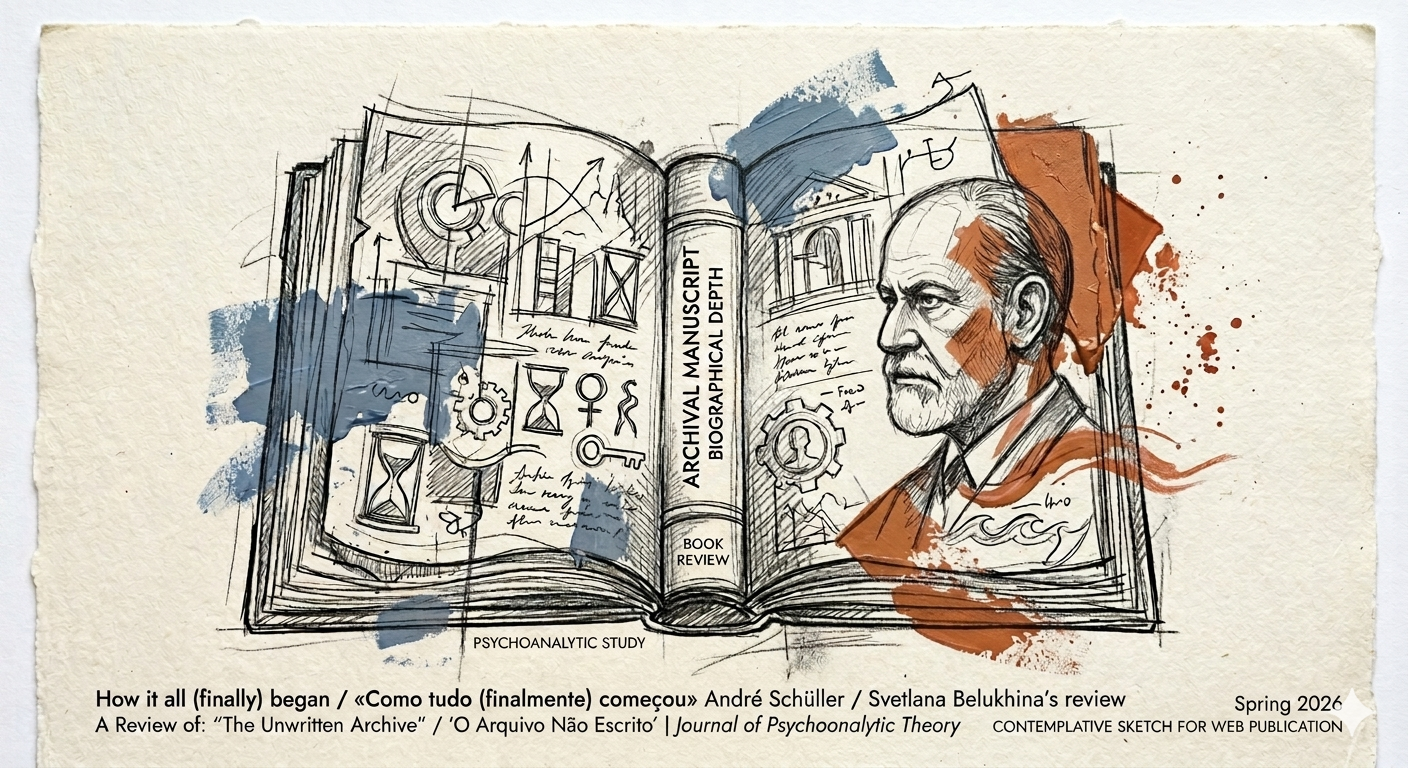
HOW IT ALL (FINALLY) BEGAN …
A REVIEW OF ANDRÉ SCHÜLLER’S BOOK “Como tudo (finalmente) começou” on working with the archives of the Freud, Nathanson, and Breuer families
Svetlana Belukhina, psychoanalytic psychotherapist, Master of Psychology, philologist
A Historiographical Reassessment of the Origins of Psychoanalysis
The book Como tudo (finalmente) começou was published by the Brazilian publishing house Appris Editora in 2025 and represents an interim summary of an unprecedented five-year historiographical study aimed at reconstructing the authentic context of Sigmund Freud’s life and work. Drawing on a vast array of previously unexamined archives, André Schuller, a Brazilian psychoanalyst, attempts a radical reevaluation of the key figures who shaped the personality and theoretical foundation of the founder of psychoanalysis.
INTRODUCTION. Methodology and Archival Research
This work is based on meticulous research of new, original archival sources, characterized by the following aspects.
First, the documentary base has been expanded. Schüller’s study draws on previously unexamined correspondence and business records pertaining to the commercial enterprises of Freud’s father—Mr. Kalmon Jacob Freud—whose role in shaping his son’s personality has been underestimated. It also includes engagement with private archives from the family of Frau Amalia Nathanson—Freud’s mother, whose social background calls for a profound and thoughtful reevaluation. Finally, it introduces into scholarly discourse a substantial body of new material devoted to Josef Breuer, a mentor whose intellectual contributions Sigmund Freud acknowledged only in part.
The final section, devoted to Breuer, initiates a process of restoring the mentor’s reputation and allows us to rethink his role in the development of psychoanalysis, a role that extends far beyond that of the mere author of the classic “Case of Anna O.”
Thus, continuing to use the family metaphor, André Schuller quite boldly calls Breuer the true father of psychoanalysis, while assigning Freud the role of the mother of the new method—the one who nurtures it and brings it into the world.
A second important aspect of André Schuller’s work is the introduction of a crucial element into Freud’s biography—linguistic authenticity—which had previously often been ignored or oversimplified. The researcher went beyond working with previously published secondary sources and turned to the “original” language of the archives, translating materials from Yiddish and Old German Gothic cursive (Kurrentschrift), which allowed him to paint a new picture of the historical canvas—a topic we will discuss in more detail in the section on the specifics of translation.
Third aspect. Relying solely on documentary evidence, the author systematically debunks the myths that have taken root in psychoanalytic circles, bringing history closer to the truth in its Platonic sense.
Thus, in his study of family dynamics, Schüller moves away from highly simplified, mythologized psychotypes—shadows on a cave wall—and presents Freud’s father and mother as subjects of a complex social and economic history, whose real biographies turned out to be far richer than their customary clinical projections.
And fourth, the book’s title—“Como tudo (finalmente) começou”—draws our attention to the processual and dynamic nature of history: it contains a subtle irony and a challenge to the claim that Freud’s story has been “finalized,” a notion we often encounter in reviews of his most comprehensive biographies, such as those written by Peter Gay, Jones, or Stefan Zweig.
André Schuller, dissatisfied with the proclaimed “definitive” nature of existing accounts, undertook an attempt to fill in fundamental gaps. By Schuller’s own admission, it was precisely the Freudian method that instilled in him the ability to sense structural inconsistencies in any material—even on such a large scale—and to continue searching for the truth.
The word “finally” (i.e., “at long last”) precisely underscores that only now are we gaining access to previously unexamined layers of the archives, and thanks to this, we are drawing closer to a better understanding of the discipline’s true origins.
The author of this study maintains a critical stance toward the very idea of “definitive” or “canonical” biographies of Freud, a notion that has taken hold over the past decades. He insists that the research is not complete and remains an open-ended project requiring constant intellectual effort and a willingness to encounter the “archival Other.”
Main Section. The Archaeology of Destiny and Overcoming the Myth
The body of texts devoted to Sigmund Freud is so vast that any claim to describe “new facts” is inevitably perceived as an intellectual challenge. It would seem that a century of archival research should have exhausted the biographical material concerning the founder of psychoanalysis. And yet, this work demonstrates that in history, as in the psyche, there is always a deeper, latent layer waiting to be uncovered. Today we are faced with the need for a delicate reevaluation of the established emphases that make up the “old myth” about Freud.
As we proceed along the path of the “archaeology of destiny” of the Great Interpreter, we must acknowledge that the figure of Freud has long transcended the purely historical context. He has been transformed into a transference space of projections, interpretations, and, in a certain sense, endless re-analyses. It is precisely within this complex coordinate system that we propose to examine new data, drawing on the concept of the document (documentum) in the sense of “stitching together” or “linking” interests and primary truths.
The Origins of the Study: From Juandia to Galicia
This work was initiated five years ago by a Brazilian psychoanalyst from Juandiaí (a city near São Paulo). During the period of global COVID-19 restrictions, when the isolation of living spaces became the new social norm, André Schuller turned his research focus to the origins—far across the ocean, to Galicia (in present-day Ukraine), the homeland of Amalia Nathanson.
Discovering that the town of Brody (now in the Lviv Oblast) was an important trading hub on the eastern border of the Austro-Hungarian Empire in the mid-19th century, Schüller sought to find documents chronicling the Nathanson family’s life in Galicia before their move to Odessa. To understand the social environment in which Amalia lived—not only during her childhood but also during her younger years in Vienna before her marriage, and later in Freiberg with her husband (now Přibor), and then again in Vienna. This made it possible to reconstruct the atmosphere surrounding Freud’s mother and move away from the simplified image of the “domineering mother” in favor of a more complex historical figure—namely, that of a young woman who came of age within a wealthy Jewish commercial and cultural social class. A woman of boundless energy, impatience, and a thirst for life.
André Schuller discovered that, before moving to Odessa, the Nathanson family was among the ten most influential families in Brody at the turn of the 18th and 19th centuries and actively contributed to the spread of Enlightenment ideas. They were deeply involved in the ideological debates between ultra-conservative Orthodox social groups and the Hasidim, and supported progressive movements. Members of the family, along with other influential figures, took the risk of bringing a progressive secular movement—the Haskalah (Jewish Enlightenment)—from Berlin. The movement advocated for a freer integration of Jews into secular life.
The fact that Freud absorbed the values of his maternal family environment—which oscillated between progress and what others considered “sinful apostasy”—provides an important key to understanding the context in which his genius took shape.
As we read the chapter on Amalia, we learn not only this, but we can also speculate as to why this marriage—considered “late” for its time—to the entrepreneur Jacob was, after all, a variation on the norm; we’ll investigate the identity of Rebecca, who vanishes from the records and was possibly believed to have been murdered either by Jacob himself or even by the couple, and we’ll also become participants in a detective-style investigation into the love story of Jacob and Amalia, their moves, and the arrival of their first child.
As the author himself writes, “With this work, I respond to all those who ‘believed and still believe’ that Freud’s parents were involved in the murder of a certain woman shortly before the future psychoanalyst’s birth in 1856 (such a hypothesis exists) or that his mother conceived him during a relationship with another man.”
After all, the figure of Rebecca, Jacob Freud’s wife during the period of 1852–1853, represents one of the most controversial gaps in the biographical background of the founder of psychoanalysis. According to archival records, her identity is linked to a serious conflict stemming from her inability to conceive, which in the Jewish community of that time was viewed as a significant flaw and justified the dissolution of the marriage. Despite Rebecca’s documented presence in the January 1853 census, contradictory entries in the 1852 border documents—with her name crossed out—point to a profound instability in her status even before her official death. The tragic aura surrounding her passing in 1854, fueled by hypotheses of suicide or violent death, formed the basis for a number of speculative theories about the “deadly secrets” of the Freud family and their possible influence on the formation of Sigmund’s unconscious. Within the framework of contemporary scholarly discourse, Schüller’s study aims to verify these narratives through a critical analysis of documents from the Nový Jičín archives, including an examination of the hypothesis that Rebecca and Sally Kanner are one and the same person.
Schüller demonstrates that Rebecca and Sally Kanner are one and the same person (Sally being the given name, Rebecca the Jewish first name). Rebecca was not “murdered”; she died of natural causes in October 1852, as confirmed by an analysis of crossed-out names in passports and registers. This is crucial: the author does not merely discuss the hypothesis; he “settles” it with documentary evidence.
To corroborate the new facts that “restore” the parents’ identities in a historical sense, Schüller searched for and translated documents from Galician archives, cross-referencing them with records of her family’s commercial activities, as well as those of Jacob’s parents’ family. Sparing no effort, he also provides an analysis of Freud’s date of birth (May 6 or March 6) to convince us that Sigmund was the child of Amalia and Jacob and no one else.
It was precisely the “Galician layer” of the biographies of Amalia Nathanson and Kalmon Jacob—and their subsequent migration—that became one of the starting points of the study, allowing us to see in Freud’s family history not a myth, but a realistic chronicle of the movement and adaptation of a young family unit in Central Europe at that time.
Along the Trade Routes from Galicia to Europe: Jacob Freud—A Reconstruction of the Father’s Image
The second part of André Schuller’s study is devoted specifically to Kalmon Jacob Freud, the father of the founder of psychoanalysis. Traditional historiography has often portrayed Jacob as an unsuccessful merchant, a socially marginalized figure, or even a man with a questionable past. The author sets out to clear Jacob’s biography of years of speculation, drawing on archival documents from Nový Jičín and the Library of Congress (Washington, D.C.).
Schüller radically changes our view of Jacob Freud, portraying him as a stable and respected businessman who was deeply integrated into the social fabric of Freiberg. He debunks the myth that the move to Vienna was an “escape” due to the tragic death of his second wife, Rebecca. The author demonstrates that this was a rational business decision linked to the expansion of the wool trade. Jacob also owned real estate (escritura de imóvel) and employed four domestic workers between 1856 and 1863. This also debunks the myth of a “flight into poverty.”
Schüller’s most important discovery is that the Freud/Hoffmann and Nathanson families were connected long before 1854. The Hoffmans were a related branch or paternal ancestors of the Freuds, whose experience in the wool trade ensured the family’s social mobility and integration into the economic life of the Austrian Empire. According to commercial registers from 1817, both families had been working in the same trade sector in Galicia and Moravia for decades. This completely disproves the theory that Jacob and Amalia met by chance in Vienna. The marriage is presented not as a misalliance between a “sinner” and a young woman, but as a traditional, legitimate, and financially sound union between two wealthy family clans. The author also debunks rumors that Sigmund was born out of wedlock, not only by analyzing his date of birth but also by finding evidence of 38-year-old Jacob’s good physical condition and his ability to father numerous children. Furthermore, Schüller emphasizes that Jacob was not merely a “reliable businessman,” but a man of noble spirit (edelkayt), a profound scholar of the Talmud, and an optimist by nature—qualities that undoubtedly influenced the upbringing of his children.
In and out. Josef Breuer—the more vibrant, authentic “father” of psychoanalysis—and his biology as the cradle of psychoanalysis.
The third part of the book is devoted to Josef Breuer. André Schuller seeks to bring Breuer out of Freud’s “historical shadow,” arguing that his role in the creation of psychoanalysis was not merely auxiliary, but fundamental.
Schüller puts forward a provocative thesis: the true “father” of psychoanalysis is Josef Breuer, while Freud is assigned the role of the mother who nurtured this knowledge and set it on its path to life. The main scientific novelty of the study lies in the fact that the author traces the origins of psychoanalytic metapsychology not to the famous “Anna O.” case (1880), but to Breuer’s much earlier 1868 work on the physiology of respiration.
It was then that the 26-year-old Breuer described the mechanism of respiratory self-regulation via the vagus nerve (known as the Hering-Breuer reflex)³. Schüller demonstrates that this biological principle served as the direct prototype for the “economic system” of psychoanalysis—the concept of the distribution and discharge of psychic energy.
Breuer was not a chance witness to a cure; he was a polymath who had successfully tackled problems in the fields of otolaryngology, physiology, and the treatment of fever. In 1880, he undertook the treatment of Bertha Pappenheim (Anna O.) already as an expert on the functioning of the nervous system. According to Schüller, the catharsis method was not a sudden flash of insight—it required Breuer’s genius, which enabled him to apply the laws of physiology (the expulsion of “stagnant” air from the lungs) to the workings of the human brain and psyche (the expulsion of “stagnant” emotions).
The historical irony of the dates is evident here: when Freud was just 12 years old, in 1868, Breuer immortalized his name with the discovery of the pulmonary clearance reflex. Exactly 12 years later, his name became inextricably linked to the “purification” of the psyche. Schüller reconstructs the chronology of this intellectual partnership and emphasizes how unjustly Breuer’s role as an emotional and scientific beacon in the sea of research into the laws of the psyche has been forgotten. Without his older friend’s fundamental discoveries and financial support, Freud would not have been able to reach the heights that he later attributed exclusively to himself.
Schüller also uncovers a previously unknown backstory to the relationship between Breuer and Freud in the documents. It is traditionally believed that they met in Brücke’s laboratory in 1877; however, the author demonstrates the existence of deep family ties through Samuel Hammerschlag, which laid the foundation for their collaboration. Hammerslag, Freud’s religion teacher, was a close friend of Breuer’s father, Leopold. Thus, the bond that formed between Sigmund and Josef in the 1870s was not a chance encounter between a scholar and a student, but a reunion of long-acquainted family circles.
Furthermore, the author reveals the psychological underpinnings of their friendship: Breuer, who lost his father and brother between 1872 and 1874, may have seen in the young Freud a figure reminiscent of his lost younger brother, which explains his exceptional emotional and financial generosity (paying for Freud’s internship, travels, and even his wedding).
Schüller deconstructs this idealization in favor of restoring the humanity of both characters, which makes them far more vivid to us, their descendants. The author expresses deep regret over how Freud later discredited Breuer, calling him “cowardly” or “limited.” Schüller insists on “restitution”—the restoration of Breuer’s rights not only as a scholar but also as a human being whose undeniable genius enabled Freud to establish his practice in the first place.
Linguistic Restoration: From Calligraphy to Meaning
Schüller’s most significant methodological contribution was his painstaking work on deciphering and translating primary sources written in Yiddish and Old German cursive (Kurrentschrift). For a long time, this linguistic barrier served as a filter through which only those facts that fit the canonical biography were allowed to pass. Schüller, however, restores the story’s authentic polyphony.
Sigmund Freud himself admitted in 1930 that, due to his secular upbringing, he could not even read the dedication in Yiddish that his father had left in the family Bible. By working with these and other documents, Schüller overcomes this “linguistic blindness”: he effectively reconstructs that part of the family memory which had been lost or consciously repressed by the founder of psychoanalysis himself.
An analysis of Old German registers and commercial directories (such as the 1817 Adressbuch) allowed the author to identify the exact occupations of Freud’s relatives. The term “wollhändlergattin” (wife of a wool merchant) in the visitor lists of the Roznov spa, appearing next to Amalia Freud’s name, serves as linguistic evidence of the family’s financial stability, refuting the myth of their poverty.
This linguistic authenticity allows Schüller to conduct a nuanced comparison between how events were described in the official newspapers of the time (such as the Neue Freie Presse) and how they were transformed in Freud’s later letters. This reveals “shifts in emphasis,” where the dry language of documents (passport records with crossed-out names or tax registers) clashes with the polished “family legend.”
By examining terms related to the Jewish Enlightenment and the disputes between Orthodox and Hasidic Jews in Brody, Schüller demonstrates that the Nathanson family was deeply integrated into progressive intellectual circles.
Translating all these specific concepts into modern scholarly language helps us understand that Freud’s genius was no accident but had deep linguistic and cultural roots in the environments of both his mother and his father.
CONCLUSION. Freud Between Document and Myth: Results of Deconstruction
The primary value of André Schuller’s study lies in a radical shift in biographical perspective: the author systematically deconstructs the sacralized, almost messianic image of Freud that has dominated historiography for the past eight decades. Instead of a simplified narrative about a “lone genius,” the reader is presented with a vivid, multifaceted figure whose theory organically grows out of deep familial tensions and social connections.
Drawing on “documented truth,” Schüller brings Freud’s “down-to-earth” parents—the stable and respected businessman Jacob and the strong-willed, energetic Amalie—back into the story, and restores historical justice to Josef Breuer, whose scientific discoveries in 1868 laid the true biological foundation of metapsychology. This process of demythologization does not “devoid” Freud of his significance, but rather makes his personality more multidimensional, contrasting the modern tendency toward simulation and simplification of the original with the complex labor of returning to reality.
The book’s methodological strength lies in “lingering on the details”—namely, in a series of careful revisitations of seemingly familiar episodes, where “new facts” emerge from a shift in emphasis and a different sensitivity to details.
Schüller demonstrates that the very act of reading archival documents—whether census records or commercial registers from Galicia—is capable of generating new knowledge by revealing hidden connections, such as the long-standing acquaintance between the Freud/Hoffmann and Nathanson families long before their meeting in Vienna.
However, this is precisely where tension arises: when a subtle psychological reading begins to blur the boundaries of historical fact, the author enters the realm of interpretation, which demands intellectual honesty from the reader.
Ultimately, Como tudo (finalmente) começou is neither a tell-all nor an apology, but a profound psychoanalytic gesture directed at the figure of Freud himself. The most compelling pages of the study emerge where the author allows his subject to remain ambiguous, without attempting to artificially “fill in the blanks” or bring him to a logical conclusion. Schüller’s work vividly demonstrates that the figure of Freud remains alive and relevant precisely because of his resistance to definitive understanding. This is yet another essential layer in the endless work of interpretation, reminding us that every new researcher analyzes not only the biography of the founder of psychoanalysis but also the very human capacity to grasp the truth through the prism of documents and memory.
Place in Contemporary Discourse and Recognition
André Schuller’s thoroughness and academic integrity have ensured the book’s popularity among practicing analysts and theorists.
The study not only supplements Freud’s biography with new facts but also conceptualizes the image of the “human” Freud—a thinker whose discoveries were inextricably linked to the dramatic and vivid history of his era, his family, and his social circle.
The work has garnered international attention. Based on the new documents, the Brazilian psychoanalytic community has requested the prompt publication of a sequel dedicated to the figure of Jakob Freud. And in May 2026, the Freud Museum in Přibor (formerly Freiberg, Czech Republic) invited André Schüller as a guest of honor and speaker “to the place where it all finally began” for the celebrations marking the 170th anniversary of Sigmund Freud’s birth. The highlight of the celebrations in Přibor was the official opening of the renovated exhibition at Sigmund Freud’s birthplace (Rodný dům Sigmunda Freuda), where the author of Freud’s “more vivid history” met with the great-great-grandchildren of the Great Sigmund.
List of sources:
Directory of Currently Active Merchants and Manufacturers in Europe (Nuremberg, 1817). Bernfeld, S. & Bernfeld, S. C. The Early Childhood of Freud. Breuer, J. The Self-Regulation of Breathing by the Vagus Nerve (1868). Gay, P., Freud: A Life for Our Time (1988). Gay, P., Freud (Respublika Publishing House, 1996). Ferris, P. Dr. Freud: A Life (1997). Ferris, P. “Sigmund Freud,” “Potpourri” (2001). Freud, J.-M. Glory Reflected: Sigmund Freud—Man and Father (1958). Heller, J. B. Freud’s Mother and Father: A Memoir (1956). Jones, E. The Life and Work of Sigmund Freud (1953). Jones, E. “The Life and Work of Sigmund Freud,” Humanitar (1996–1997) Klein, D. B. Jewish Origins of the Psychoanalytic Movement (1985). Miller, E. The Deadly Secrets of Dr. Sigmund Freud: False Theories, Real Murders (2016). Romano, C. The Rebekka Case. Sajner, J. Sigmund Freud’s Connections to His Birthplace, Příbor (1991). Schneider, G. Sigmund Freud (2008). Schüller, A. How It All (Finally) Began: The Documented Stories of Freud’s Mother, Father, and Mentor (2025). This, B. The Golden Book of Psychoanalysis. Tögel, C. Studies on Freud’s Life (2021). Zweig, S. Healing Through the Spirit (1931). Zweig, S., “Healing Through the Spirit,” “Folio” (2022)
Archival Collections:
Sigmund Freud Papers (Library of Congress, Washington, D.C.) State District Archive of Nový Jičín
Official Registers and Statistics:
Registers of the Jewish Community (Matriken der Israelitischen Kultusgemeinde) Wiener Medizinische Wochenschrift (Vienna Medical Weekly)
Correspondence: Brautbriefe (Letters to the Bride)
Periodicals of the time: Neue Freie Presse, etc.
This review was first published on May 25, 2026, in the Ukrainian Psychoanalytic Journal. Reproduction of the text is permitted provided the author and the website http://headology.org are cited.
Share Twitter WhatsApp Telegram VK Svetlana Belukhina