Mental Illness: It’s Not Just in Your Head
These days, we hear a wide variety of psychiatric diagnoses and psychoanalytic terms more often than usual. When talking with friends, at work, in the news, or in the movies we watch, we frequently come across phrases like: “She’s depressed,” “That sounds like schizophrenia,” or “He’s a narcissist.”
We wonder, “Well, what about me?” We go online and, as we read about one disorder or another, immediately recognize its symptoms in ourselves. Then, faster than any doctor, we diagnose ourselves—after all, we urgently need a label to bring some sense of certainty, to quell our anxiety, and to put a name to what’s troubling us.
But what are the chances we’ll hit the mark? Even experts currently struggle to provide clear criteria for what constitutes normal versus pathological behavior in mental health.
For example, we don’t know for sure whether internet addiction should be considered a mental disorder and treated as such. Are those who label the natural grief following the loss of loved ones as depression and prescribe medication correct? What about children with behavioral difficulties? How soon should they be classified as having attention-deficit disorder?
There are no clear-cut answers to any of these questions, and the emphasis on classification that we see today in society and among professionals leads one to believe that all of this is done merely to categorize people and avoid feeling such intense anxiety while trying to understand what is actually happening to them.
Psychiatrists have their own “Bible” for this purpose—the DSM, or “Diagnostic and Statistical Manual of Mental Disorders.” Like an encyclopedia, it lists descriptions of mental disorders.
An encyclopedia is, of course, a useful thing, but by reading only it, we won’t be able to fall in love with literature or with life; we won’t be able to empathize with the characters, follow the plot with interest, or become experts in any particular genre.
Perhaps by reading books and living through story after story—including our own—we can begin to appreciate not only literature but also the life it describes, and our own place within it. So, if we diagnose ourselves or someone else based on an encyclopedia, we reduce an entire universe of individual experiences and feelings to a single short phrase and confirm that we believe everything is standardized and that somewhere there’s a magic pill that will instantly rid us of our symptoms.
But if we shift our focus from diagnoses and dictionaries to stories, if we reframe the question “What’s my diagnosis?” into a reflection on “What happened to me?”, “How and why did I end up here?” or “What brought me here?”, then we’re bound to recall something recent, then something from our family history, something hereditary, relationships with significant adults, encounters and partings, as well as the social and economic circumstances in which we were shaped or in which we currently live.
And if we take a closer look at all of this, it’s easy to see: the factors that contributed to the emergence of psychological suffering are not only not inside the brain, but not even inside the person.
Upon closer examination, we see that the factors that contributed to the emergence of various forms of psychological suffering are not only not inside the brain, but not even inside the person.
It’s easy to forget this in an era when we’ve come to understand the brain as a combination of countless receptors and neurotransmitters and believe we can influence it directly. But this organ does not exist in a vacuum; it exists within the human body, which, in turn, exists within a family, a culture, a society, and an economy.
And if the factors that contribute to a specific mental illness are also found outside the brain, it follows that some of the solutions may also be found outside the brain.
Let’s consider the diagnosis of “major depressive disorder.” What can we learn from it? Not much. But if we try to piece together the story of the person who has been diagnosed with it, we’ll see that, for example, she is a 46-year-old woman, a mother of two children. She has been experiencing depressive symptoms for the past three months (depressed mood, insomnia, poor appetite, and weight loss). Her condition has worsened due to psychosocial factors (lack of permanent housing, debt from a loan following her divorce from her husband). Among the negative circumstances is the fact that, during her childhood, her parents encouraged her dependence on them, and as an adult, she handed over control of the family budget to her husband. Her mother and maternal grandfather were hospitalized with a diagnosis of “depression.” Positive factors that can be leveraged in treatment include the fact that the client has a job and friends; she is willing to cooperate in long-term therapy.
The second diagnosis, “major depressive disorder,” can be summarized as follows. A 55-year-old man, a former screenwriter, is currently divorced twice and has no children. In his youth, he wrote screenplays but did not succeed and became a manager in the industrial sector. Over the past year, he has been fired from his job twice. At both jobs, he developed conflicts with his superior—a man—which were accompanied by strong aggressive impulses. He tried to cope with his disappointment through alcohol (there was no history of alcoholism in his family; on the contrary, there was a strong emphasis on a sober lifestyle). Then he quit abruptly, after which his condition improved, his vitality increased, and his desire to find a job and meet a woman returned. But after his initial success, he turned back to alcohol, began to feel apathetic, and complained of the futility of his efforts, a lack of any desires, and constant drowsiness.
As we can see, the diagnosis is the same—but the stories are different. In a sense, the diagnosis is like a stamp, while life stories are, of course, fingerprints—unique to each person. The combination of predisposing, accelerating, and protective factors will always vary, creating a unique personal pattern in which the key to recovery is already encoded; it simply needs to be revealed and brought into conscious awareness.
In both of the examples given, treatment with medication alone will not lead to a sustained improvement in the client’s psychological and emotional state or to an enhanced quality of life.
In both cases, long-term psychotherapy is recommended as a means to help clients develop a new model of fulfilling relationships with themselves and others; the foundation of a safe and trusting relationship with the psychotherapist will then enable them to independently build professional and personal relationships in the future.
However, there are other initiatives that, at first glance, do not fall within the realm of mental health but are important for improving a person’s emotional well-being.
In the first of the hypothetical cases we presented, the client’s unstable living conditions and financial dependence contributed to a growing sense of hopelessness and a loss of meaning in life. Therefore, alongside therapeutic work on her psychological issues—such as building self-confidence, fostering a sense of security, and developing the ability to be independent—it would be helpful to guide her in finding resources to improve her living conditions, as well as in selecting and completing courses in vocational retraining or personal finance management.
And in the second case, focusing on how and where a person can apply their creative abilities as a screenwriter (and as the screenwriter of their own life as well)—abilities they abandoned long ago—will help restore their zest for life.
Therefore, let us emphasize once again: by thinking of mental health issues solely as the antics of an isolated and disembodied brain, it is easy to overlook the most important point—the fact that a person and their psyche are a unique complex phenomenon, the result of the interaction of a combination of biopsychosocial factors.
We must not limit ourselves to either a medical or a psychoanalytic model—any crisis, including a mental one, is always a chain of events. Therefore, a space for collaboration must be created where both a mental disorder such as schizophrenia and a physical disorder such as diabetes can be safely and carefully explored.
The biopsychosocial perspective may be of interest to anyone who has ever reflected on their own mental health or on the factors that contribute to a harmonious psycho-emotional life. Stable, satisfying connections between mind and body, emotions and physiology—formed through creative interaction with another person—a therapist—are the foundation of mental health.
None of us is static; we change and we change others. Who we are today depends on the sum of the things that have already happened along our path. But this does not mean that it will always be this way. We can change this by embarking on a psychotherapeutic exploration titled “I want to know what my story is and how I can write it differently.”
This article is based on an adapted translation of materials from The New York Times dated March 15, 2019. Opinion author: Lisa Pryor, M.D., author of The Little Book of Pills.
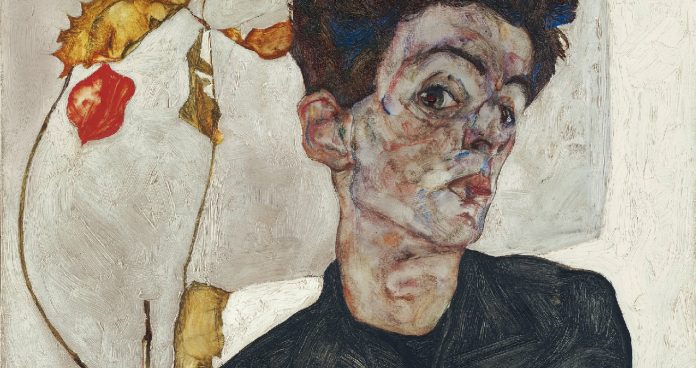
Illustration: Egon Schiele, detail from “Self-Portrait with Physalis,” 1912.