Instead of an Angel: You Were Never Here
This is a mysterious, almost detective-like story. It features a gripping mystery, surprising coincidences, and a protagonist who strives to uncover the truth despite a lack of evidence. In our own attempt to reconstruct the sequence of events, we, too, can rely only on the facts that have come down to us and our own response to them; therefore, we do not strive for documentary accuracy, but rather invite the reader to immerse themselves in a fictional exploration of Salvador Dalí’s long-standing, obsessive attachment to a single painting.
What Is Hidden Always Comes to Light
We might think that this story began in the 1960s, when Salvador Dalí approached the Louvre administration with a request to have an X-ray taken of the painting The Angelus by the French realist artist Jean-François Millet.
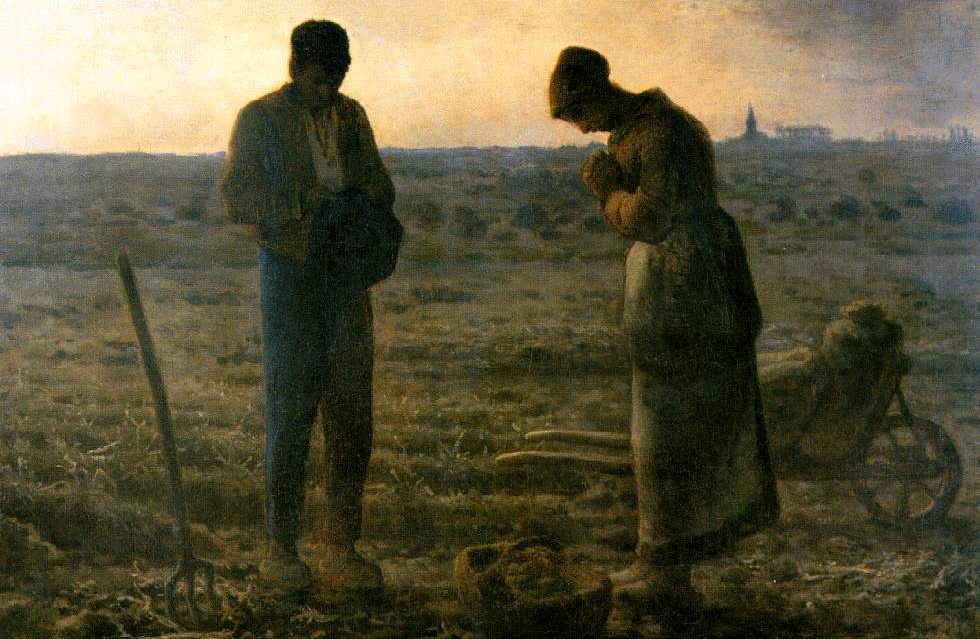
It is an ordinary painting: a peasant couple, a man and a woman, standing in a potato field bathed in the rays of the setting sun. They are praying. Right in front of them on the ground is a basket of freshly dug potatoes, and the outlines of a town and a town hall are visible on the horizon. Art historians have always interpreted this scene as an evening prayer for the harvest, but Dalí, for some inexplicable reason, could not bring himself to believe it. The subject had haunted him since childhood; he felt an inexplicable connection to the painting and sensed a mystery within it.
Long before X-rays were used to study paintings, Dalí began his own investigation: he redrew Millet’s figures many times, trying to understand what troubled him so much about this scene, and came up with new interpretations of it time and again.
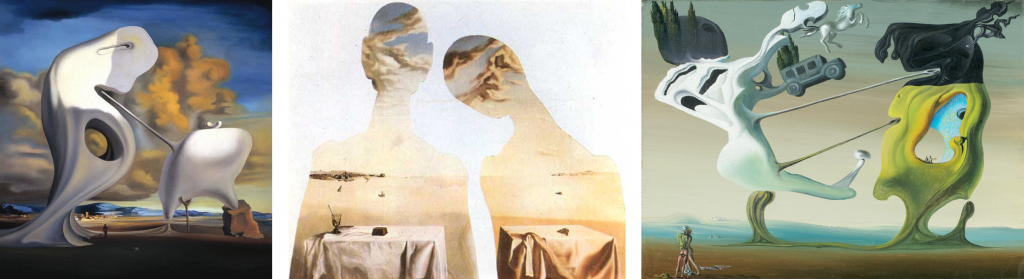
Figures from The Angelus appeared in one form or another in his works more than 60 times, and we can see this for ourselves by closely examining his body of work.
The mystery was solved when the X-ray images arrived. It turned out that hidden beneath the basket of potatoes, over which a man and a woman are leaning, is an image of a small coffin. It seems that the painting was originally conceived as a scene depicting the funeral of a young couple’s unbaptized infant, for whom there was no place in a Christian cemetery.
Afterward, Millet’s own memoirs were carefully examined, and it turned out that, yes, to boost sales, the artist had decided to change the subject matter to something “lighter.” He wasn’t much of a cover-up artist, though, since he didn’t alter the figures of the man and woman, who radiated a grief disproportionate to the occasion.
Dalí commented on the X-ray findings as follows: “I have always sensed death in this painting.”
What’s important for us is that Dalí alone did not trust that “picture of reality” insisted upon by Millet’s subject matter, whereas most people felt no contradiction whatsoever.
An Encounter with a Masterpiece
Delving deeper into our investigation, we might surmise that this mysterious story began earlier—namely, during Dalí’s childhood.
A reproduction of Millet’s painting hung in the hallway of the school run by the monks of the “Society of the Blessed Virgin Mary,” and, most likely, the young Dalí would often linger in front of it on his way to class, perhaps examining the painting through that very crystal decanter stopper which, as he wrote in his autobiography, he always carried with him to view the world through.
Dalí admitted that in his younger years he “lived under the spell of dreams and reveries”: he loved drawing and disliked other subjects; he adored gazing at the cypress trees outside the window and the water stains on the ceiling rather than listening to the teacher. Thus, this faceted crystal prism, both literally and figuratively, refracted his reality and gave it whimsical contours. We might think that it could have been both an object of physical reality and an important intrapsychic mechanism that defined the artist’s mode of thinking.
It was precisely this tendency to transform the internal and the external that likely led the young Dalí to perceive a stirring incongruity in Millet’s painting and, subsequently, to unravel the painting’s mystery and discover entirely new meanings—for himself and for the world—within a thoroughly traditional subject.
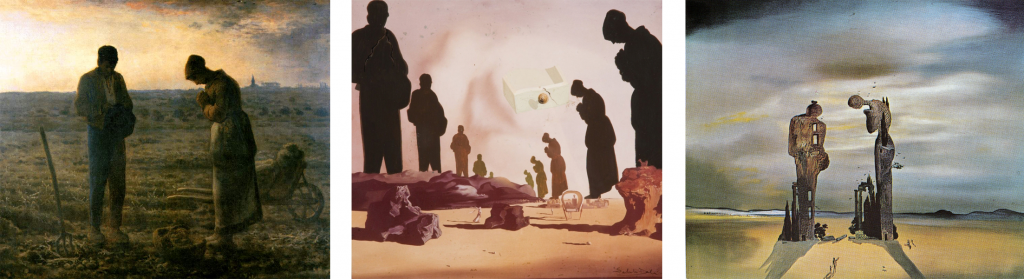
As we noted earlier, he created many variations on the theme of The Angelus. Here are just a few of them: “Gala and Millet’s ‘Angelus’” (1933), “Millet’s ‘Architectonic Angelus’” (1933), “Archaeological Reminiscence of Millet’s ‘Angelus’” (1935), and others.
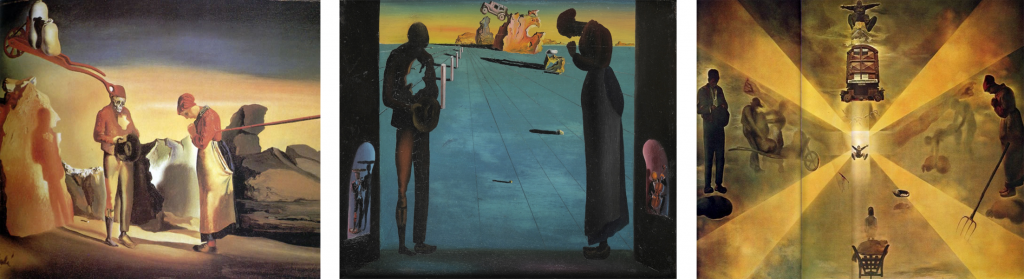
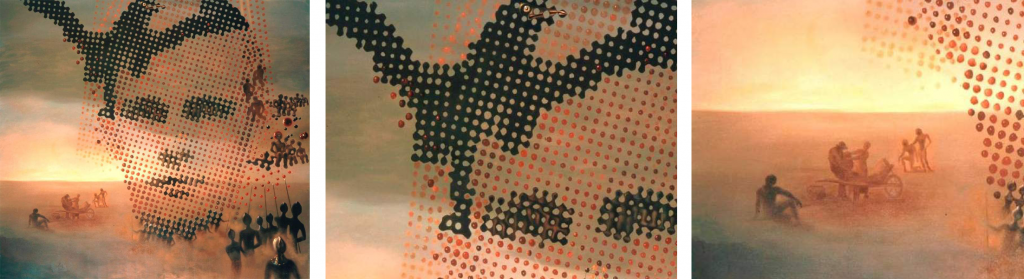
Dali played with the figures from “The Angelus” as if they were dolls: in particular, he used them in “Portrait of the Viscountess de Noailles” (1932) and in the illustrations for “Maldoror.” They also appeared as two skyscrapers in the drawing City (1935) and became the protagonists of A Couple Floating in the Clouds (1936). The silhouettes from The Angelus can also be seen in the background of the composition Perpignan Station (1965), which embodied Dalí’s idea of the center of the universe.
Trauma Before Trauma
Having already delved into the almost “architectonic” layers and clearly recognizing Dalí’s interest in the young couple in Millet’s painting, we might say that this mysterious story began, perhaps, on Dalí’s birthday, when he met his parents…
Dalí was born on May 11, 1904, nine months and ten days after the death of his older brother, also named Salvador, who died on August 1, 1903, of meningitis at the age of nine months and eleven days.
For parents, the death of a child is perhaps the most difficult experience in life. The grief is immense, immeasurable. Along with their child, parents lose a part of themselves—their future. Coping with all the overwhelming emotions is difficult, at times unbearable. They can find comfort in each other’s arms, and soon it becomes clear that a new child is on the way, even though the pain of their recent loss has not yet subsided.
“There is no love without loss, and it is impossible to overcome loss without experiencing grief. The inability to grieve prevents one from entering the great human cycle of death and rebirth”—the words of Robert J. Lifton.
Sometimes the inability to grieve is linked to a denial of what has happened, to a desire to “undo” the tragic event and unconsciously replace the deceased infant with a new one, as if erasing the fact of the first child’s death. Thus, grief comes to a standstill and halts any kind of psychological life against the backdrop of continuing life in the physical world.
Often, a sign indicating unresolved grief is not so much the short interval between the date of the deceased child’s death and the birth of the new one, but rather the parents’ stubborn refusal to acknowledge the death, as well as their desire to make the two children similar—for example, by choosing the same name for the newborn that the deceased child had borne. Dali’s parents named the new child the same name as his brother, and for this reason, among others, he can be called a replacement child.
Dali admits: “All my eccentric antics, all my absurd ideas, can be explained by the tragic desire that has haunted me my entire life: I have always wanted to prove to myself that I exist. That I am me, and not my late brother.”
“Every child wants to be loved for their own sake, and not at all because they evoke the memory of a loved one or play someone else’s role,” writes V. Volkan in his work Life After Loss. And it seems that when Dalí speaks of the search for his own “self,” he is referring to a strong desire to separate his identity from that of his deceased brother.
Studies of the life stories of replacement children show that not every replacement child faces identity issues as they grow up. So why was it difficult for Dalí to feel like himself?
Psychologists suggest that the merging of the stepchild’s identity with that of the deceased may occur as early as the embryonic stage, when the pregnancy has already begun, and the previous grief has not yet been processed and is, as it were, frozen.
Here, it finally becomes clear to us that this story began even before Dali’s birth. Dali’s mother, having not yet come to terms with the loss of her first Salvador, becomes pregnant again. She is not yet ready to devote herself to a relationship with the new child, for the space for this new encounter in her psychological landscape is occupied by her unresolved relationship with the deceased: those feelings of protest, anger, and guilt that she may experience following the loss. And also by shock, denial, bargaining with fate, anger toward the child who is gone, toward her husband, and toward fate itself. Without realizing it, she transmits these feelings to the new baby even before birth, but especially during the first months of his life, when he needs her so much. The new child is expected to replace the deceased one. And so, instead of being himself, he becomes the embodiment of an idealized image of the first child, and this becomes an unbearable burden.
If we view Millet’s painting as a symbolic scene of Salvador Dalí’s conception—featuring his parents and the presence of his dead brother—we might consider the grief “hidden beneath the potatoes,” a sorrow that remains unspoken, existing within his parents’ psychological space. It is not surprising that, under such circumstances, the scene of conception appears simultaneously as a scene of death, and we find confirmation of this in Dalí’s words, when he describes with utmost clarity his experience of coming into this world: “I experienced my death before I lived my life.”
This angel of death constantly hovers over the replacement child: both parents, fearing they will lose this new child just as they lost the previous one, may become excessively protective and indulgent toward the infant. But at the same time, they will tend to unconsciously direct their grief and aggression—which is not actually intended for the child—toward him. Thus, little Dalí might have felt his parents’ grief over his brother as grief for himself, which was simply baffling: How could this be? Why are Mom and Dad grieving, when I’m right here and I’m alive? In the young child’s psychological world, there is no name for this contradictory feeling, but Millet’s painting somehow conveyed it, and Dalí grasped it.
It is precisely this duality, conveyed by the parents, that shatters the child’s fragile psyche, as delicate as crystal. The role of acting as a substitute angel for the child is both pleasant and incredibly burdensome. Primordial narcissism and a sense of omnipotence come to the rescue, but they do more harm than good: the child unconsciously takes on the imposed ideal role, even though on some other level he always knows that his parents love him—sort of.
The fact that this new player—the surrogate child—enters the parents’ “game against death,” and thus against life, permanently blocks the parents’ own grieving process and creates a peculiar, distorted sense of time and space in the child’s psychological world. As he grows up without having gone through the necessary stages of psycho-emotional development, the substitute child is confronted with the harsh realities that do not support his fantasy of himself, and this overwhelms his psyche: he suffers increasingly from internal conflict.
We know that Dalí never aligned himself with any artistic community; he was a loner, and only Gala—his muse, wife, and, in a certain sense, his “mother”—served as his link to the world. For many years, Dalí tried to cope with his trauma through his art, battling his deceased brother, who was hidden in his mother’s psyche and later in his own, as if beneath a basket of potatoes in Millet’s painting.
“To reconcile this alien, irrational, and paranoidly haunting body of his dead brother with the rational, critical part of his psyche in order to tame it” might have meant for Dalí: to see, to acknowledge, and to mourn—so that he could say goodbye and continue living.
Over time, all his feelings emerge in one form or another on the surface of his consciousness and on his canvases: the horror of rivalry with his dead brother, the pain of losing his parents’ love, anger at everything that had happened, the helplessness of being unable to change anything, survivor’s guilt, his feelings for Gala as a projection of earlier emotions, and, of course, fantasies about what the moment of his conception must have been like under such circumstances…
Dalí never ceases to reflect on this in ever-new variations of Millet’s Angelus, where he plays with the male and female figures in various ways on the improvised stage of his canvases.
Rebirth, or…
Come to think of it, everything that was hidden has indeed become apparent—in Millet’s painting, in the story of Dalí’s birth, and to some extent in his unconscious fantasies, but certainly in one of the motifs of his work. What was once tragic and unexpressed can now be observed, and, most importantly, discussed. There is no room left for denial.
It is believed that the work of grief comes to an end when sorrowful experiences are not suppressed, and words and images are found that give meaning to what has happened and allow one to confront the memory of the deceased without avoiding it. If this process is given sufficient space in both the real and the psychological realms, then grief comes to an end, and a person can look to the future with hope, building new relationships of love and attachment.
Can we say that Dalí found enough space for this? He made about 60 attempts to interpret just one painting by Millet, and his entire creative legacy comprises more than 1,500 works of art: paintings, illustrations, set designs, engravings, sculptures…
The fact that Dalí remained, as it were, glued to the subject of The Angelus for so many years speaks to the extent to which his identity was fused with that of his deceased brother and with an unconscious fantasy about the moment of his own conception. Since Dalí had seen, from childhood, a part of his subconscious magically embodied in an object of the physical world—in this painting—”The Angelus” eventually became for him what is known as a linking object.
V. Volkan: “We use linking objects to recreate unresolved relationships with the deceased in the external world and to resurrect the conflict. Linking objects create the melody of relationships, but ironically, they also prevent the bereaved from adapting to the change and continuing their normal lives.”
Can we then assume that all of Dalí’s attempts to “distance himself” from the realism of Millet’s painting—which he undertook throughout his life by creating numerous variations on this scene—served his desire to break free from the original images of his unconscious and, finally, to be symbolically reborn? The tenacity with which he worked with this material testifies to the strength of his desire to live, to unravel his subconscious, and to feel like himself.
We cannot be certain today that Dalí succeeded in doing the work of grief on behalf of his parents, much less in becoming “an angel” in their place. We can only note that he became who he became—the great mad Spaniard, the eccentric Andalusian dog sniffing out the truth about what is actually real and what is not.
And Dalí likely found the answer to his central question intuitively long before the X-ray was taken, although it was still necessary, since it allowed him, in a sense, to soothe what he called the “dislocations of consciousness.” An explanation was found for the contradictory sensations that had troubled him since childhood.
An interesting fact: although Freud’s work had an enormous influence on all the Surrealists, Dalí himself met with him only once—and not in a psychotherapeutic setting. It is said that after that meeting, Freud left the following words for posterity: “What interests me most about Dalí is not the content of his unconscious, but the content of his consciousness.”
In closing, a few more words about the analytical tool that Dalí initially “applied in his investigation” unconsciously, but later with increasing purpose. This surrealist crystal decanter stopper, that inner prism, which so distorted reality, familiar forms, structures, and concepts—it blocked off time and space, yet still allowed him to get to the bottom of at least one truth, as well as to bring figures from the unconscious to the surface of consciousness and transform all of this into a vast artistic legacy. This—if one may say so—tool or mechanism, pre-programmed into his thinking, is what made him who he is, rather than his brother, whose portrait he finally painted at the age of 59, thereby definitively distancing himself from him. Definitively?
September 10, 2018
The author of the article is psychotherapist S.V. Belukhina. Read more…
Republishing is welcome provided the author’s name and the source http://167.235.57.68 are cited
Cover: Jean-François Millet, “The Evening Bell / Angelus,” 1857–1859
Sources:
Gibson, Y. The Mad Life of Salvador Dalí, Moscow; (1996). Millo, K., Ordinary Abysses (Catherine Mllot, Abîmes ordinaires. Paris: Gallimard, L’Infini, 2001). Dalí, S. The Diary of a Genius, Moscow; (1991), The Secret Life of Salvador Dalí, Written by Himself, Moscow; (1996). Millot, K., Dali and I, Moscow: Limbus Press (2008). Rojas, K. The Mythical and Magical World of Salvador Dalí, Moscow; (1999). Benoit, B. The Substitute Child, L’enfant à naître (2005).
Share TwitterWhatsAppTelegramVK Svetlana Belukhina