The Film “Dovlatov”: Beyond Proofreading
The film “Dovlatov” by Alexei German Jr. reminds us of the eternal conflict between the creator and the system, the futility of seeking compromise with society, the communal nature of thought, as well as the unresolved tragedies of the past that continue to haunt us today.
A Suitcase from the Loft
The Moscow spring of 2018, though sunny, is snowy, heavy, and unhurried. With an indecisive gait, it makes its way through meter-high drifts of settled snow. When you look at these drifts, you think—they won’t melt until August.
That’s why, on one of the first sunny days, you especially want to pull a stepladder up to the closet, open the overhead compartment doors, and check how the clothes set aside for spring have fared over the winter: have the colors faded, have moths chewed through the cuffs, do the pockets need mending… It’s as if, by rushing time along, you’ll believe that the cold will retreat, the thaw is just around the corner, and the sun—no longer pretending—will warm our hearts.
But then one of the suitcases—old, heavy, and dusty, having not been opened for many, many years—suddenly starts to fall… It seems impossible to catch it. It flies to the floor, hits my arm painfully with its edge, and lands, opening up like a book.
Artifacts from a bygone era spill out before our eyes: thick Finnish socks, a double-breasted suit, official-style low-top shoes, a Fernand Léger jacket, a belt, a poplin shirt, a winter hat made of faux seal fur, chauffeur’s gloves… And an old family album.
Just like this suitcase, Alexei German Jr.’s film Dovlatov fell right on viewers’ heads this spring, stirring up memories and drawing them into a long-forgotten story.
It was originally planned to stay in theaters for just four days—it appeared and then vanished. It was shown, but not to everyone. It was printed, but the print run was immediately destroyed. It’s the same feeling you get in the morning after a strange dream. It’s not exactly a nightmare, but a disturbing, vague haze—clinging, rattling, and relentless. After all, if it were a nightmare, you’d remember it, go out to the kitchen, and tell your family, “Can you believe it? I had such a dream.” But for this dream, you can’t even find the words… only: “Where the night goes, there goes the dream.”
In Alexei German Jr.’s film, Dovlatov has dreams, and the very first one is about Brezhnev, who looks like a member of the creative community. In the dream, Sergei chats with him like a friend, seeks his advice, and they plan to co-author a book that will finally be published. Published as a joint work.
But in reality, we see that Khrushchev’s Thaw is long past, and harsh times have now set in. Brezhnev is by no means the “wise father” from the dream. He has firmly held the position of General Secretary of the USSR for seven of the past eighteen years, setting a conservative course, and under the guise of fighting parasitism, he wages a battle against subjectivism and freedom of thought. Only in this way, according to the authorities, can a people who have survived tragic events be kept functioning. Only in this way, it seems to them, can the nation’s consciousness be “unified”—and certainly not through strange, free-thinking texts penned by neurotic writers like Brodsky and Dovlatov.
Dovlatov’s writings are full of irony; they are not being published. Brodsky has already served his sentence; he has only one year left before leaving the country. Literary life in Leningrad has come to a standstill. The only works that get through are lighthearted, life-affirming texts “without a hidden meaning.” The writer’s choice is limited—emigration or joyful hymns.
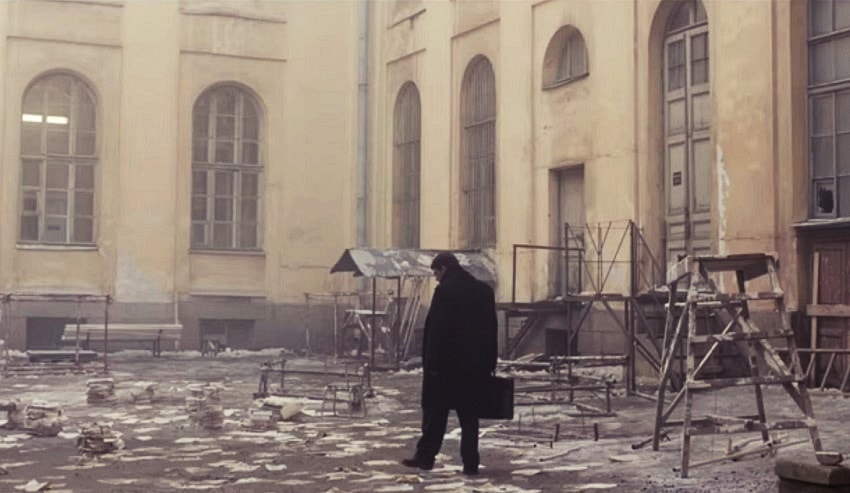
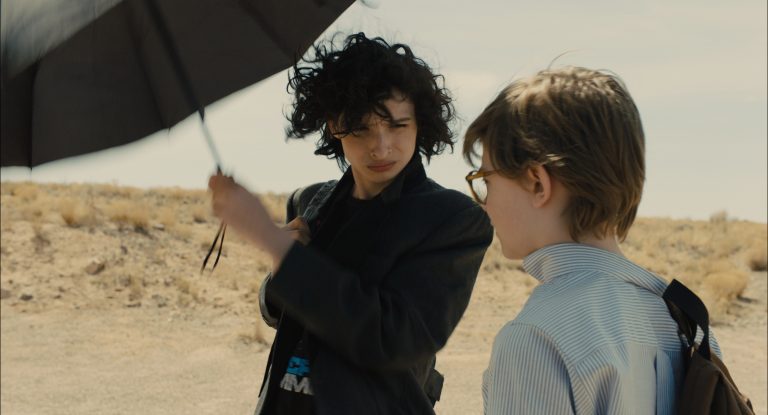
Still from the feature film Dovlatov (dir. Alexei German Jr., 2018)
Society truly did not have enough of Khrushchev’s Thaw. It was not enough to melt the frozen ground of the traumatic experience of an entire people who had endured wars, repression, camps, and the deaths of their fathers… How many years will it take for these towering snowdrifts to melt under the sun’s rays? For the deposits of this cold grief—frozen into inexpressible horror in the eyes of mothers and passed down in wordless lullabies to the children of this restless era—to turn into clear streams? Certainly not just four days in theaters. Well, at least until August.
Sergei’s second dream transports us right into the camps, where the guard’s Dovlatov-style crew cut is indistinguishable from those of the prisoners. This flips the perspective and raises a legitimate question: who is the victim? And, as always, yesterday’s victim becomes today’s aggressor, the aggressor becomes the rescuer, and the rescuer becomes the future victim. The vicious cycle continues, and there is no way to escape it as a decent person. The hopelessness of the camp—this psychological blockade—permeates both Dovlatov’s dream and all of objective reality. Dovlatov knocks on the doors of editorial offices; his work is not published; he drifts from one smoke-filled apartment party to another, but he simply cannot find a compromise with the system.
And is there even a chance? The hallmarks of this system: dissociation from emotions ⓘDissociation—a psychological process classified as a defense mechanism. As a result of this mechanism, a person begins to perceive what is happening to them as if it were happening not to them, but to someone else., the puppet-like nature of the characters and the plasticity of their roles, a general emotional numbness, and narrow-mindedness. The director reflects that there are two ways to cope with the negativity of such a massive psychological trauma: either as the faceless shipyard worker does, reporting, like a robot, on the work done and universal happiness, or by being ironic and laughing, like Dovlatov, slyly turning words inside out—and with them, reality itself.
Where we are rushing to—whether it is hell or a paradise, or simply gloom and darkness—remains unknown. Dear country, a constant subject of praise, is it not love? No, it has no name. Joseph Brodsky, “Nostalgia: From the Outskirts to the Center” (1962)
The answer to the question—whether any compromise is possible at all—lies deep underground: we find it in the story of the encounter between the protagonist and the subway worker-poet. The subway worker ultimately chooses poetry, no matter how incomprehensible it may be to the system at this moment. He packs his feelings into words and “sends” them on a journey through time to future generations, in the hope that they will one day understand.
Here, in the underground scene where the subway builders mourn a school class that perished in a bombing, a certain idealized land is revealed to the viewer. That land seems to have been luckier than ours—it isn’t so littered with bones. Does that mean some people suffered less than our people did? Could it be that someone’s lullabies were more meaningful and truly soothing? Well, those of future Rothkos or Steinbecks, for example…
“I’m better than Steinbeck,” Dovlatov tells his friend. “Better.”
But for the system of that time, it didn’t matter how much you were truly yourself or how deeply you were capable of feeling; the main thing was to be part of this enormous mechanism, this communal apartment the size of a nation.
In it—in this standardized apartment—the residents sort of knew one another, sort of loved and sort of hated one another; they gave birth and died while adhering to common rules, and kept everyone who lived there on a short leash. Outsiders were expelled.
Such a communal living arrangement, of course, provided protection, first and foremost, from the madness of realizing the scale of the grief endured. But it also gave rise to what might be called a communal mindset, which covered common sense with a sticky web of idealization, preventing people from accepting the tragedy of their experience, finding a way to mourn, and beginning the grieving process so that, having grieved their losses, they could finally begin to live, and thus feel something other than the system-mandated, sanitized collective joy.
The sound-permeable walls and the absence of door partitions in this dormitory, which was as large as a country, left almost no room for imagination. Most of Dovlatov’s life was spent in a Leningrad communal apartment, and whatever later unfolded before his inquisitive gaze in the life of society, it was all an extraordinarily intense emotional experience, comparable, perhaps, only to scenes of communal life that we would now call too intimate.
A child growing up without a firmly closed door to shield his psyche from premature experiences is deprived of the opportunity to speculate and fantasize—and thus, to grow psychologically. An entire generation of people thus remained eternal children, taking everything that happens too literally, allowing no room for doubt, imagination, or creativity, and not bothering to seek deeper meaning; they expect ready-made solutions, five-year plans, and clear meanings from a leader—whether liberal or authoritarian.
In Dovlatov, as we can see, the conventional way of dealing with the facts of reality provokes an inner protest: the writer is brimming with meanings and wants to share them. But his meanings are not accepted precisely in Russia, where making one’s voice heard is of the utmost importance. For a long time, this leads him neither to active struggle nor to flight, but manifests itself in hopelessness, depression, and a creative block. This peculiar refusal to accept an unbearable reality and to process it creatively in some way is something like a strike within the writer’s psychological space, frozen in anticipation of when his words will be accepted by the system.
But to the system, this word comes from another reality; in socialist reality, it is reduced to nothing more than scattered fragments of manuscripts, getting soaked in the Leningrad rain. We see him during a period when his literature cannot be preserved for posterity, but can only be passed on to his children in the form of waste paper—old, unwanted paper destined for recycling. Needless to say, the system of that time treated not only texts this way, but also the people who were trying to create.
The dreariness, the smoke-filled air, and the literally stifling atmosphere in which Dovlatov lives vaguely remind us of something. Perhaps it’s that period of stagnation, or perhaps it’s already another one. That tightness in the chest. There isn’t enough fresh air.
The protagonist’s pent-up energy is partially released through the same addictions—smoking, alcohol, and affairs—but it can never truly be released: neither can it sweep over the city as a hurricane of creative rage, nor rage like a thunderstorm over the editors’ desks, nor pour down as a fine, depressive rain, washing the sidewalks and streets of his native Leningrad and bringing liberation… No. The intensity of his feelings never finds a fully satisfying creative outlet, neither in film nor in life. And, despite the fact that in exile Dovlatov managed to become a successful writer, one can assume that all that which remained unspoken and unnamed—all that which was directed at his native country—accumulated within his psyche; and although it was at least partially numbed by alcohol, in the end, led to his absurd demise. True, this happened only in 1995. But in 1971—well, really, only in “collaboration” or collusion with the Brezhnev who appeared in his dream, so reminiscent of Dovlatov’s beloved literary master Hemingway—was a book-story-life of the son of the system even conceivable. Otherwise, the environment in which these communal relationships thrive—where all roles are blurred—would not accept his perspective on events and, fearing exposure, would not acknowledge it, would not print it, and would not publish it.
Family Album
So, there are no separations. There is a grand reunion. It means that someone suddenly suddenly embraces us around the shoulders in the darkness, and, filled with darkness, and, filled with darkness and peace, we all stand together above the cold, glistening river… Joseph Brodsky, “Nostalgia: From the Outskirts to the Center” (1962)
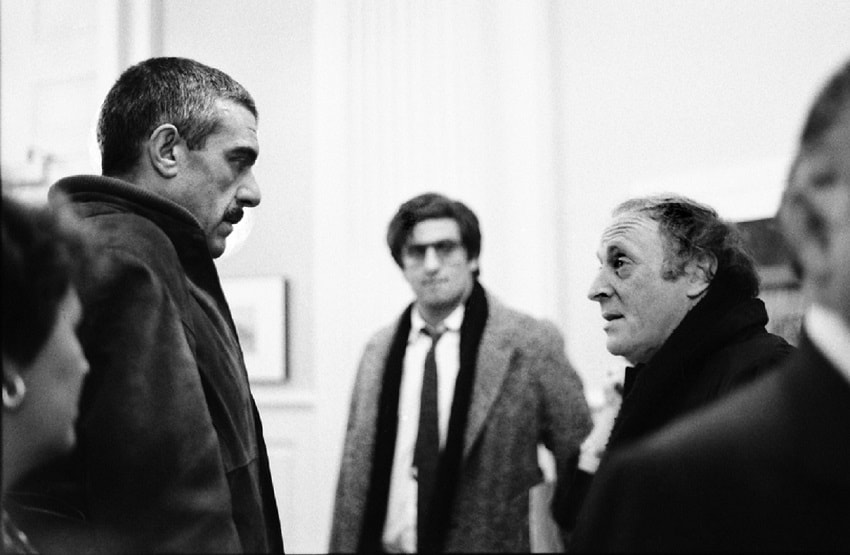
Dovlatov and Brodsky / photo: © Nina Alover
Modestly, for just a few days, Alexei German Jr. travels back to a bygone era, to the time of his parents’ youth. They were around 30 then, just like Dovlatov in the film. Leningrad, fall 1971—a meeting place with those who have already passed away. A chance to remember them, to think about them… And now the viewer, together with Dovlatov and Brodsky, stands “above the cold, glistening river.” Sailors march past in formation. Our heroes light up a cigarette. Viewer, don’t you smoke? Don’t be surprised—here, in the film, you’ve lit a cigarette, and the smoke you exhale is already taking on whimsical shapes. What kind of fantasies and thoughts are swirling within it?
Perhaps it’s the question: Why are we here? What compels us to confront this longing, to wander aimlessly through the streets of a beautiful yet dark city, to gaze intently at the figures of the past? What are we looking for? What answers, and to what questions?
Perhaps it’s yet another attempt to look back and understand what it was about that era—about our parents—that we inherited but never fully grasped? What lies in that dusty suitcase that has fallen from the attic of our soul? Whose photographs are they? How did these people live? What did they feel on the other side of the proofreader’s mark?
Galich’s lines come to mind:
For someone else’s sorrow
and for someone’s uninvited childhood
we will be repaid with fire and sword
and the shame of lies,
the pain returns,
because it has nowhere to go…
What are we to do with this pain? How can we come to terms with it so as not to pass it down from generation to generation?
Here we are faced with such a difficult task that each of us will have to think it over and decide for ourselves whether to take it on. After all, when we open the family album of the past, an irresistible urge to idealize will sweep over us from head to toe. Are we ready to resist this impulse so that we might have a chance to discover and accept the contradictions and duality of reality? Or do we want the past to be nothing but heroic, our mother’s stories the most vivid, and our father’s the most inspiring? This path is tempting; it seems like a paved road along which we can stride confidently toward a bright future. But in doing so, we may fail to notice the treacherous poppy fields on either side of the road. Their intoxicating, sleep-inducing potion can plunge us for a long time into a beautiful world of unattainable illusions.
Idealization always goes hand in hand with demonization or devaluation. So the “bad, dark” aspects of a person’s character will inevitably be separated and projected onto someone else. What, then, will we see? We’ll see amazing, wonderful, kind, talented people on one side and talentless, heartless scoundrels on the other. Take Sergei Dovlatov’s loving, understanding, caring mother: she believes in her son’s talent and is willing to work hard herself so that he doesn’t give up on his dreams of great literature. And then there’s the woman from the editorial office—a narrow-minded, intimidated stickler for rules… These women seem to be cut from different cloth, yet their sons drink with both of them.
The most acute social phantasm of the first half of the 20th century: to be a man is to perish. The maelstrom of revolutions, wars, and repressions swallowed up fathers one after another—by the hundreds, thousands, and millions. To be or not to be a man is tantamount to Hamlet’s “to be or not to be.” In a mother’s mind, this question might have sounded like this: Should my son be a man and perish, or remain a “boy” by my side and save his life? A mother may think that as long as her son dreams of something grand and not very realistic, he will not enter into a struggle that could prove fatal—the struggle to realize his plans. Such feelings accompany a mother’s parting with her maturing son in any era: just yesterday he was catching her approving glance, and today he is setting out on his own path, following his recklessness and creative impulses. He makes mistakes, but in doing so, he learns about life and himself. It is a difficult decision for a mother—to let him go. It is no less difficult a decision for the child—to dare to embark on a journey of his own. The hard times and tragic events of the era make this parting—this coming of age—unbearable.
At the outbreak of the Great Patriotic War, Dovlatov’s mother—Nora Sergeevna Dovlatova—is pregnant. Thanks to the help of acquaintances, she manages to escape from Leningrad to Ufa, where Sergei Dovlatov is born on September 3. Five days later, the siege of Leningrad began. With what feelings did she raise her son? How did she cope with her anxiety for him? What emotional strength would it take for her to give him freedom and let him go? Freedom could turn out to be his undoing.
Having switched from a career as an actress to that of a proofreader, she takes control into her own hands. A proofreader is a guardian of the word. They are called upon to ensure order and are intolerant of errors. An error would signify vulnerability—a raw, unprotected spot, an Achilles’ heel. In his memoirs about Dovlatov, Alexander Genis offers the following reflections:
“A mistake is a trace of life in literature. It connects fiction with reality, just as the part connects with the whole. A mistake brings a breath of freedom into a space fenced in by narrative logic. It is a sign of the natural, whereas infallibility is a deliberately artificial—and therefore lifeless—construct. A world without mistakes is a dangerous, totalitarian fantasy, like any utopia. By correcting, we improve. By improving, we destroy.”
“As is well known, in our newspapers only the misprints are true,” writes Dovlatov himself.
Sigmund Freud attached particular significance to errors, seeing in them an uncontrollable, spontaneous manifestation of unconscious desire or conflict—and thus of life itself.
Without disregarding the tragic realities of the time, might we suppose that Nora Sergeevna’s control over errors could have served as a source of Dovlatov’s own unconscious internal control over himself, his self-expression in life and literature? Could Dovlatov have been unconsciously “complicit” in the non-publication of his works? Dovlatov is like the large steamship we see in the painting. It lies at anchor, hesitating to set sail. The dream of great literature… the promise to become a writer, made to his mother at the age of eight… Time seems to have stood still on that day…
Is Dovlatov destined to fulfill his childhood dream? If not in the USSR, then in the U.S.? Or is this dream merely a fantasy of an imaginary, unattainable world and an ideal land? Why was the promise he made to his mother as a child so important to Dovlatov? What was he trying to prove?
We can only speculate. His parents valued literature: Sergei’s mother had a masterful way with words and was a talented storyteller; his father, Donat Mechik, was a theater director and headed the literary department at the theater. When Sergei turned eight, his parents divorced. His father left, leaving a void behind. And Sergei made a promise to himself to become a writer.
His father’s legacy—the surname Mechik—though it was the second part of Sergei’s double surname, was, over time, seemingly adjusted in favor of his mother’s once-Armenian surname—Dovlatyan. This adjustment served as a protective shell against the passage of time. Everything was polished, erased, and crossed out.
In this regard, it is interesting to note that, according to those who knew him personally, Sergei Donatovich Dovlatov did not like being addressed by his patronymic and insisted on being called simply Seryozha. “A giant with a child’s heart,” is how the writer V.I. Solovyov described him.
Thus, his father’s name gradually faded from his story…
And in this article, of course, there should have been a place where we could talk about Dovlatov’s father, or about Dovlatov as a father, or about all the fathers and grandfathers of that era… But, meanwhile, it’s no coincidence that the real father never appears in Alexei German Jr.’s film. Vanished fathers, forgotten men, erased mistakes. All that remains is to dream or construct their ideal images. But we know that without a father, there is no creator.
Alexei German Jr.’s film ends, and the screen telegraphs to us how things will turn out for the protagonist: first, emigration; then, a prolific period; and finally, a tragic death.
There is such a concept as “metal fatigue,” writes the author V.I. Solovyov, noting in his memoirs about Dovlatov just how emotionally drained he had become by the mid-1990s:
“Dovlatov definitely suffered from a weariness of life, whether it was emotional exhaustion or a decline in literary talent. All right, let’s call it a euphemism: a decline in his writing activity.”
Sergei himself said that at that time he had only “desires without desire.” The fatigue of metal—and especially of damask steel, as Dovlatov seemed to be—is, it seems, not merely emotional fatigue, but mental exhaustion and depression. Psychoanalysts would call it libidinal disinvestment. But we won’t go so far as to make such a categorical statement.
Solovyov himself—who was criticized for mentioning Dovlatov’s alcoholism in his memoirs—claimed that the umbilical cord connecting him to Nora Sergeyevna had never been severed. Thus, after Sergei’s tragic death, his mother said she had lost not a son, but a friend. She bequeathed her ashes to be buried in her son’s grave, which was done. “Even death did not separate them,” Solovyov wrote in The Tragedy of a Cheerful Man. “On the contrary, death was what united them. Forever.”
“Your time is up.
Your time is up; end the conversation.
End the conversation.”
The movie Cinderella, a scene at the ball
The journey to an imaginary land is coming to an end. It’s time to return.
We’ve spent these past few days in a world of fantasy and memories, masterfully woven by a couple—director Herman Jr. and his wife, production designer Elena Okopnaya. It truly feels as though we’ve gone from a spring that never quite began to a lingering fall—a season that is both happy and tragic. Dovlatov was born in early September and died tragically on August 24, on the threshold of autumn. For the country he so longed to reach, autumn is both a joyful time of the first school bells and a time of mourning for the victims of the Siege of Leningrad, for losses and sorrows.
Here it is: a family’s story within the history of a nation. Our family album. In it, joy and sorrow intertwine, permeating life. Nothing can be cast aside. Are we capable of finding a place in our hearts for both—just as they are, without editing? The film Dovlatov helped us reflect on this.
Authors of the article: psychotherapist S.V. Belukhina. Read more… and clinical psychologist M.S. Petrosyan. Read more…
Republishing is permitted provided the authors’ names and the source URL http://167.235.57.68 are cited
First published in “Monocle” on May 15, 2018
Share Twitter WhatsApp Telegram VK Svetlana Belukhina