“Unorthodox” or Where Is Esti Running?
During the COVID-19 lockdown, civilized people suddenly lost their customary freedoms and crossed a certain line into a territory all too familiar to everyone from childhood—the realm of restrictions and prohibitions.
Political, professional, and social communities have shrunk to the size of small communities, now defined by the capacity of Zoom conferences or the bandwidth of internet channels.
Caught up in the rituals of quarantine, there’s no room for the impulse to seek knowledge; even simple curiosity isn’t welcome here, because for a curious barbarian… a mask won’t help. So here we are, following the rules, staying home, washing our hands frequently, and wearing personal protective equipment—even though we don’t really understand whether any of this actually helps against the virus…
Esti—the heroine of the new miniseries Unorthodox—also doesn’t understand much about the countless rituals and practices that govern her life in the Satmar ultra-Orthodox Hasidic community in New York.
This is a community of Jewish survivors—and those who continue to survive to this day—that remains impenetrable to the outside world. The Satmar Hasidim, concentrated in the Williamsburg neighborhood, are a small ethnic group that was subjected to extermination during the Holocaust, just like other Jews around the world. But what sets this particular group apart is their cultural self-isolation, which serves, among other things, to “program” young couples to have as many children as possible.
It was once believed that this would help them make up for what was lost, process the trauma of their ethnic group’s near-extinction, and revitalize themselves. But today, this phenomenon can be viewed as a form of psychological defense, in which rituals serve not for emotional processing but are performed with the aim of compulsively relieving anxiety through action (Freud, 1920, 1921; Kernberg, 2014).
It’s not just Esti who is in the dark about the meaning of Williamsburg’s vast array of diverse rituals; the viewer isn’t given many explanations either. For example, it’s unclear why the furniture in the houses is covered with plastic wrap, what role the aluminum foil plays in the kitchen during a holiday, why women shave their heads and then wear someone else’s hair as a wig… and much, much more. We can Google it and find some explanations for these cultural peculiarities, but Esti can’t—she doesn’t even have a phone. Not only is communication forbidden in the community, but nothing new is allowed either; the main goal is to preserve the old ways.

Bang-bang, oh-oh-oh, my little bunny is running away
Reviews of the series often describe it as a story of escape. And indeed, Esti, having finally become pregnant after countless ritualistic and painful attempts to conceive (she has vaginismus), flees the community. She doesn’t go just anywhere—she heads to Berlin.
Today, this city is a center of freedom, creativity, and creation. But once upon a time, it was different—a different community where not being Aryan meant certain death. Now, open-minded, creative, sensual, and empathetic people from all over the world gather here.
In Berlin, our heroine meets a group of musicians who welcome her into their circle; she performs a ritual ablution in the lake where Jews once perished, and embraces the rules of this new world and this new game.
Esti’s mother had also left for Berlin long ago, and their ancestors lived somewhere here before the war. Therefore, it seems that Berlin is indeed the place where the heroine will come face to face with the tragedy of the peoples—her own and that of a people that was once so cruel—as well as with her own long-standing pain: her resentment toward her mother for abandoning her as an infant.

The reunion with her mother doesn’t happen right away. Esti waits. Her new musician friends introduce her to Berlin, tell her about the freedom to choose how to live and love; explain how liberating it can feel to be part of a music ensemble, an orchestra, or a student community; and help her prepare for her conservatory audition.
If she passes the audition, she’ll be able to pursue music—something she’s always dreamed of, but which women in Williamsburg were forbidden to do, since nothing was supposed to distract them from their roles as wives and mothers…
It’s likely because the expectations placed on women in the Hasidic community are so immense, and the very essence of womanhood is understood there in such narrow terms. It is from this narrow-mindedness, from the appalling exploitation of women for the sake of preserving the ethnic group, that Esti is fleeing. “I’m not a baby-making machine,” she declares.
But what if Esti’s escape isn’t just a rejection of the sacred role assigned to her as a woman—what if it’s the beginning of a “journey” toward her true self? Even if, as a journey, it cannot yet be fully understood—neither by her nor by those who set out in pursuit of her: her husband Yanki and his friend Moish. A journey that will answer the question: What does Esti want? Does she want marriage, a child, to save her nation, or does she want (and have the right to) find her own voice? Does she yearn for union, phallic power, resonance, or for something else to emerge in her inner world besides the suffocating Orthodox community? For example, a living, warm mother who would sing the lullabies she so desperately needs… Who would teach her how to wear dresses. And also, to have a sufficiently good Winnicottian parent nearby—a warm and creative Berlin for both of them…

It’s surprising (though some might say predictable) that a loving mother turns out to be found precisely in Berlin. And this is not only her biological lesbian mother, who has already fulfilled her need for maternal love in a relationship with a German woman—but also the mother-conservatory and the mother-student community.
Esti meets her biological mother at that dramatic moment when Moische leaves the gun he had been threatening her with on the playground and walks away, saying, “You’ll come back [to the community]; I’ve come back.” Terrified, Esti then runs headlong to her mother and finds refuge with her. She learns that her mother did not abandon her of her own free will, but had long ago lost a custody case against the community in court.
That’s why Berlin—both distant and close—could now become such an important stop for Esti. Here she will try to find her orchestra and her own musical instruments to play or sing the sorrowful song of her people and her personal tragedy.
Interestingly, the series’ first script was titled The Orchestra, which brings to mind Winnicott, who compared an infant’s holding to an “ensemble” of attention that surrounds the child from the very moment of birth (Winnicott, 1998).
Such a holding is a prerequisite for everything necessary to occur—allowing Esti herself to truly be born—before the one who can later give life to a new human being is born within her inner world. Psychologically.
Before a symbolic parent capable of containing and processing the immense psychological trauma of an entire ethnic group can be born, a person must be born who dares to undertake the necessary existential journey to answer the question always present in the soul of the Sphinx: “Who are you?”
It is obvious that no single person can do this alone. Another person is needed—friends and fellow travelers: the children of the world, who now understand and share in the immense tragedy of the twentieth century, and who realize just how orthodox and rigid we all can be at certain periods of life or at certain moments in the development of human civilization (Bollas, 1993).
In the beginning was the Word, and that word was correct…
The Greek word “orthodoxy” consists of two roots that can be translated as “to think correctly” or “to hold the correct opinion.” For this reason, the term “orthodox” is used primarily to refer to religious people who adhere to a conservative way of thinking: they reject innovation and change, make no attempt to rethink this life, and are content with “the word once spoken” and approaches adopted long ago—even though these approaches may no longer meet the challenges of our increasingly complex modern world.
The film’s heroine grew up in such a community, and, of course, all of this defines her. But she, a child of this culture, is also someone else.

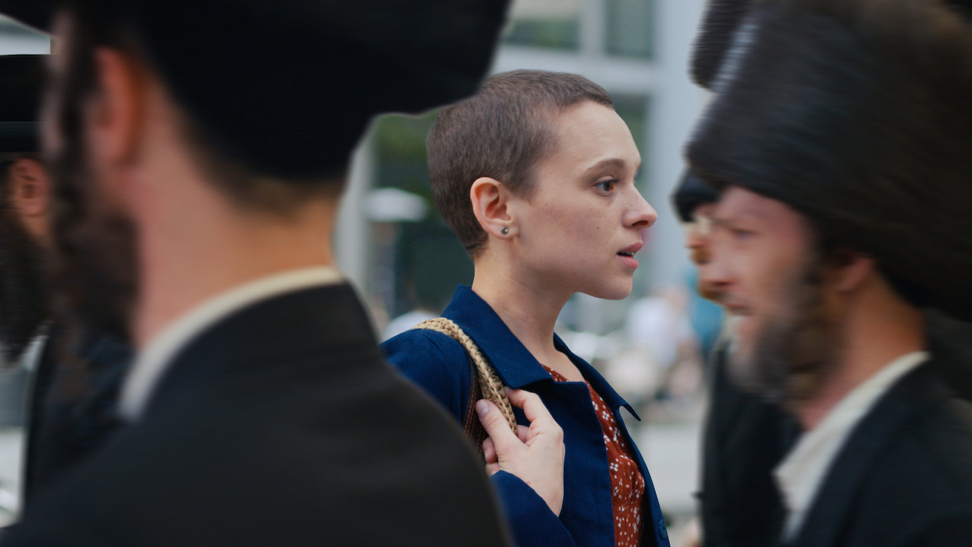
When we look at this tiny girl with a large head, enormous eyes, a slender build, and a narrow pelvis, we can’t be mistaken—she isn’t yet ready for marriage or the role the community has assigned her. This is how enchanting elves and Japanese anime characters are portrayed. From the very first frames, Esti speaks to us through her extraordinary appearance, rather than through words. And we find ourselves wondering: why was an actress with such an unusual appearance chosen for this role? In what language does the director wish to speak to us? Is this already his “Word,” or is it something even more pre-verbal?
It’s also interesting to consider the role of the Word in the Hasidic community. It’s clear that speech there is endowed with exceptional functionality and is not intended to express feelings. It is needed to announce, report, or retell.
But can such speech be called the Word? The speech is narrow, pure, and hermetic. Its purity is strictly guarded; neologisms must not penetrate it, and wordplay and words conveying negative emotions—anger, bitterness, envy—are not permitted.
“A person is part of the language,
which is older than he is and which will continue
to exist even after
time has dealt with its servant.”
B. Youngfeld
All feelings, except the “proper” ones, remain underground in the community—or, to put it another way, “in Esti’s narrow, pure vagina”—unspoken, unmitigated, causing exceptional pain, and thus preventing anything new from coming into being.
After a lavish wedding filled with an atmosphere of shame and awkwardness, the heroine cannot joyfully follow the commandment to be fruitful and multiply; she experiences pain and eventually learns that she suffers from vaginismus. Moving forward is unbearable for her, both literally and figuratively.
And here we have yet another message that needs to be deciphered—at the level of the body.
A mother absent since infancy, an alcoholic father, a backward community, a meager cultural environment—who will help Esti make sense of herself? If she lacked meaningful communication in childhood, how will she develop the ability, in adulthood, to be in touch with her own body and mind? Not only generational trauma, but also her personal childhood trauma of abandonment—this is why she cannot fully process emotional experiences or cope with bodily tensions, affects, impulses, and anxieties (Bion, 1962).
In a psychoanalytic setting, the analyst typically helps fill these gaps and reconstruct what is missing. But Esti cannot see a psychoanalyst. She cannot even see a secular gynecologist. The community does have its own homegrown practitioner, but her methods do not help the heroine at all.
The fact that Esti was nevertheless able to conceive as a result of a violent, painful encounter with her husband is a cruel metaphor for a small ethnic group’s attempt to survive and be reborn through pain. But at what cost? Can a small woman withstand such strain and transform all this pain into love, if she herself was deprived of a soothing word?
During the period of communal seclusion, Esti senses that she is very different from other women, yet she cannot put her feelings into words. There are no labels, no symbols. She decides to tell her husband, Yanki, that she is not quite ordinary (whatever that might mean). This is an act of great trust and hope; however, Yanki is just as much a child of the community as she is, and there is little he can do to help her.
In this insular culture, as we see, there is no way to even begin to describe experiences that differ from the generally accepted and “correct” ones; there is almost no chance to acknowledge the existence of complex, ambivalent feelings.
Another example of Esti’s verbal boldness in the film is when she dares to pose a riddle to her mother-in-law: “If you expect me to treat your son like a king, then since I am his wife—does that mean I am a queen?” But this is the limit of the verbal play she can afford.
Her physicality, her emotionality, her voice, the ability to play with meaning—all of this has been taken away from her.

Which songs heal?
The Word, which is meant for a person to rethink and reaffirm themselves in this world, is taboo in the Satmar Hasidic community. Emotional speech is unbearable; only functional speech, used as an obsessive repetition, is permitted.
Men read and recite the Torah and sing what we would now call positivist, exalted songs. These compulsive chants consist of separate, unconnected syllables, and they are not a gentle lullaby—no. Even mantras or affirmations would sound more lively. Women are forbidden to sing at all.
So is it possible, under such conditions, to make sense of a traumatic experience? On an individual level, on a group level?
After all, trauma is a concept that tells us we must listen sensitively—whether in cultural discourse or in folk songs—to what cannot be conveyed in words, to something preverbal… We need to allow ourselves to be surprised, to be shocked by the fact that such a historical experience is difficult or, in principle, impossible to describe, since within the traumatic madness lies an inarticulate event that is seeking a way to be expressed (F. Davoine, J-M. Gaudilliere, 2004).
The brilliant psychotherapist and thinker W. Bion, who survived the war and worked extensively with trauma survivors, says that “a thought is always looking for a thinker.” There must be someone nearby who already knows how to perceive, who can hear the strange song of the unconscious.
In one of the flashbacks that fill the Berlin portion of Esti’s story, we see her catch her grandmother secretly singing a Jewish song and weeping for the dead. At first, Esti sternly scolds her grandmother for singing, but isn’t it this very incident that later helps the heroine decide to break the rules and begin secretly taking piano lessons from a teacher who isn’t Hasidic?
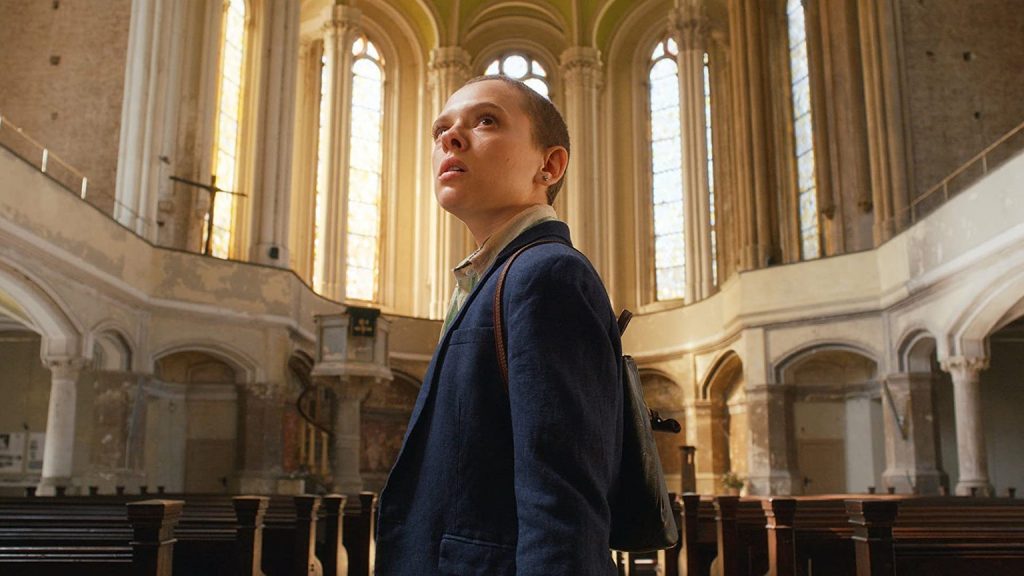
And later, in Berlin, one day we see that Esti is enchanted by a song—she is captivated by the choral singing in a Catholic church… Could it be that in this singing, her sensitive ear picked up something very similar to her grandmother’s song?
Probably. That’s why, at the audition, Esti won’t play the piano as she had planned. She’ll sing. Her voice will become her main instrument and move the audience to the point of trembling when she performs her people’s song with deep feeling, wearing the dress her mother gave her.
In the finale of the fourth episode, we’ll be struck by the stark contrast between the Esti who steps out of the Berlin airport—where her mother and son are hugging noisily and emotionally right beside her, while she looks tense and stiff—and the Esti who sings her song from the stage.
Fly, fly, petal, from west to east, through the north, through the south… come back, having made a circle
People today can freely express themselves and their feelings in various offline (and, during self-isolation, for now only online) spaces; you just need to know the “music notation.” That’s partly why it feels a bit strange now to recall that this right once had to be fought for. It seems all the more absurd that someone like Esti still has to do this today. But the quarantine and the new rules of survival serve as a reminder of this, as does the TV series Unorthodox.
Often, what’s new is just the well-forgotten old… What was once ultra-Orthodox Berlin—whose goal was to preserve the purity of the Aryan nation—is now a hub of creative self-expression for people from all over the world, while at the heart of progressive New York lies an ultra-Orthodox Jewish community…
But the freedom to write and speak in the modern world, too, at some point became something unquestionable—and thus, to some extent, “correct”—transforming into a new canon that has once again been called into question by the 2020 infodemic.
New, long-forgotten canons… Uncomfortable (or comfortable?) skinny jeans instead of a wide skirt, an earring instead of a niqab, and a fluorescent stamp as a pass to a dance club instead of Shabbat prohibitions… All of these are strange symbols to which we attach one meaning or another. They can instantly become the foundation of a new orthodoxy when survival takes precedence (Yeremin, 2015).
And language itself, the Word, unfortunately, can be used not for the purpose of development, but to preserve the old, to encapsulate oneself, to barricade oneself in various psychological bunkers and shelters (Bion, 1957; Steiner, 1993).
“The difference between a hero in war and a deserter
lies in which direction he runs
when he gets scared.”
W. Bion
Culture provides us with patterns of upbringing and survival, codes of conduct, language, and much more. As Freud (1921) wrote: “Every individual is a constituent element of the masses and—through identification—a subject of multifaceted relationships….” So how does it work? Does Esti find herself through this stage of her journey, or does she merely find a new “proper” community, simply located elsewhere? Won’t Berlin become her new psychological refuge?

How can we tell when we’ve gone from being unorthodox and open-minded to becoming die-hard orthodox believers? Do we have a way to recognize this, or are we still trapped in the suffocating society of the Sphinx, as if standing at the blackboard without having learned the lesson: Tell me, who walks on four legs in the morning, on two in the afternoon, and on three in the evening? Of all the creatures living on earth, none changes as much as he does. When he walks on four legs, does he have less strength and move more slowly than at other times…?
We all know the answer and the story of Oedipus, but what will Esti’s answer be? Recall the riddle about the Queen that she posed to her mother-in-law. Is this a question of the Oedipus complex, as understood by classical psychoanalysis, or something else?
“It is striking that the female Oedipus complex does not resolve in the same way as the male one,” wrote Janine Chassagé-Smirzhel. “Women tend to perpetuate the Oedipal situation… But eventually, a woman does lean toward choosing to belong to a man, to be created for him, rather than being an end in herself; to be a part of him, ‘the rib of Adam,’ rather than perpetuating her loyalty and attachment to her mother. “We—both men and women—are born of a woman… And the myth of Origin, in our view, conveys precisely our shared desire to free ourselves from her…” (Chasseguet-Smirgel J., 1964).
As for the answer to the riddle of orthodoxy versus unorthodoxy—it seems to lie in movement. Of all creatures on earth, none changes as much as he [man]—so the saying goes.
The riddle of the Sphinx in the modern world is no longer a riddle about who a human being is; it is a riddle about how to remain human, to continue being human. And this is possible only through change, psychological movement, and the existential journey undertaken by each individual in their own life and by all of humanity throughout history.
This is possible thanks to a journey—not in the sense that, according to Tullius, ends with a return, but in the sense that Joyce came to understand by the middle of Ulysses—that one-sided movement familiar to Brodsky, which carries a person “away from” and beyond the boundaries of space. That irreversible course, which Virgil was the first in literary history to describe as “the hero who never returns; he always departs…” (Youngfeld, 2012).
Brodsky has some sad and beautiful words to say about this: “Return becomes impossible not only because of a rotten political system, but for other, deeper psychological reasons. A person simply moves in only one direction. And only away—away from a place, from that thought that came to mind, from oneself… and this is always a departure from what has already been experienced… An ever-increasing distance from the source, from yesterday…” (Youngfeld, 2012). Remaining in the anxiety of uncertainty, without memory, without desire, a person moves toward the new (Bion, 1962).

All of the above makes the series Unorthodox a rich container in Bion’s terms. In the world of contemporary culture, this is an event that encompasses a multitude of meanings and transformations. This cinematic work gives meaning to and names a wide variety of feelings, highlights the paradoxical nature of our emotional experiences, our desires, and our systems of signification, and reminds us of the importance of remaining open to continuing our journey, exploration, play, and life.
Quarantine and self-isolation will end, and our daily series will continue. Unorthodox will have a new season, and perhaps it will already be about the story of a young couple.
Run, Esti, run, little rabbit… Fly, planet Earth.
May 15, 2020
Author: S.V. Belukhina, psychoanalytically oriented psychotherapist, author of http://167.235.57.68
Stills from the film Unorthodox were used as illustrations
The following sources were used in preparing this text:
Winnicott, D., Young Children and Their Mothers, Moscow: Klass, 1998. Eremin, B., “The Fascist State of Mind: A Psychoanalytic Perspective.” Moscow: Selected Works of the ECPP, “Beyond the Pleasure Principle,” 2015. B. Eremin, “Seminars on ‘Bion’s Thinking,’” 2017–2019. Karut, K., The Archive, the Event, and Historical Trauma, 2015. Kernberg, O., Severe Personality Disorders: Psychotherapy Strategies. Moscow: Independent Firm “Klass,” 2014. Mazzacane, F., “The Game of the Unconscious” Seminars, 2020. Mazzacane, F., In the Analytic Game. Moscow: Independent Firm “Klass,” 2015. Pinker, S., Language as an Instinct. Moscow: Librokom, 2013. Ferro, A., Psychoanalysis: The Creation of Stories. Moscow: Independent Firm “Klass,” 2006 Freud, S., “Beyond the Pleasure Principle” (1920) // Freud, S., The Psychology of the Unconscious. Moscow: STD Firm LLC (Educational Edition, Vol. 3). Freud, S., “Group Psychology and the Analysis of the Ego” (1921) Freud, S., “The Ego and the Id.” Selected Writings. Book 1 — Tbilisi: Merani, 1991, pp. 71–138. Freud, S., “Obsession, Paranoia, and Perversion” // Freud, S., Collected Works in 10 Volumes, Vol. 7. Moscow: STD Publishing House, 2006. 308 pp. Eco, U., “To Say the Same Thing, But in Other Words.” Moscow: AST, 2015. Eco, U., The Search for the Perfect Language in European Culture. Alexandria, 2007. Youngfeld, B., “Language Is God.” Corpus, 2012. Bion, W. (1957) “Differentiation of the Psychotic from the Non-Psychotic Personalities” // The International Journal of Psycho-Analysis. – Vol. 38. – pp. 266–275. Bion, W. (1962) Learning from Experience, London. Bollas, C. (1993) The Fascist State of Mind, in Being a Character, London: Routledge. Chasseguet-Smirgel, J. (1964) “Female Guilt” (On Certain Specific Aspects of the Female Oedipus Complex). In: New Psychoanalytic Research on Female Sexuality, Payot, Paris, pp. 129–180. Davoine, F., Gaudilliere, J-M. (2004) History Beyond Trauma, London: Other Press. Lopez-Corvo, R. (1997) God Is a Woman – Janson Aronson Inc, Northvale, NY, London. Steiner, J. (1993) Psychic Retreats: Pathological Organizations in Psychotic, Neurotic, and Borderline Patients. Routledge.
Republishing is welcome provided the authorship and source (headology.ru) are cited.
This article was published in the academic journal Journal of Clinical and Applied Psychoanalysis, Volume 1, Issue No. 2, 2020
Share Twitter WhatsApp Telegram VK Svetlana Belukhina