“Loving Vincent”: An Artistic Exploration of Van Gogh’s Illness and the Causes of His Death
On November 9, 2017, the film “Van Gogh: Loving Vincent” was released in Russian theaters. I invite you to immerse yourself in a psychoanalytic artistic investigation of the possible causes of Van Gogh’s death, to learn about his struggle to find his identity, about the close connection between mania and melancholy that accompanied the artist throughout his life (today this condition is known as “bipolar disorder”), and how the bipolar nature of his personality influenced Van Gogh’s art.
“He felt deeply, he felt tenderly…”
The film “Van Gogh: With Love, Vincent” is a testament to the incredible hard work of everyone who participated in its creation and their immense faith in its success. The film reflects the artist’s own thirst for life and, most importantly, is a gift of love from the modern world to the long-gone Vincent—that unconditional love he so desperately and persistently sought from his mother and which he ultimately managed to awaken in humanity through his art.
This is the world’s first feature-length animated film painted entirely in oil. Over the course of more than five years of production, 115 artists from around the world worked to create 65,000 paintings in order to bring Vincent’s 120 original works to life and tell the story of the life—and mysterious death—of the greatest artist of the 19th century. The director and producer is Oscar-winning Hugh Welchman. The music is by the magnificent Clint Mansell, composer of the soundtracks for The Fountain, Requiem for a Dream, Black Swan, and others.
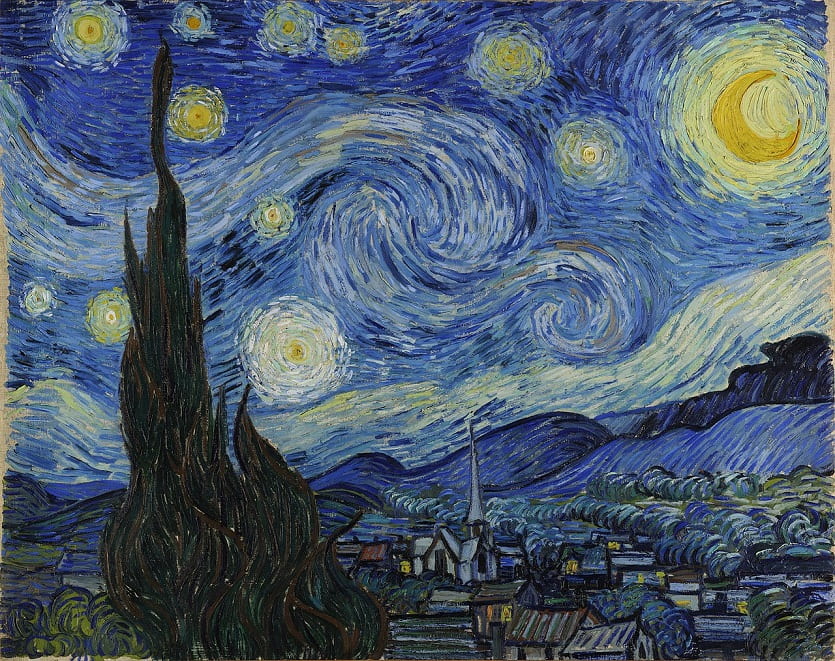
Vincent van Gogh, “Starry Night” (1889) / Google Art Project
The film “Van Gogh: With Love, Vincent” is a unique work. The screenwriters moved away from the traditional biographical approach to immerse the viewer in an almost psychoanalytic investigation, much like what takes place in an analyst’s office—with resistance, forgetting, and repression, followed by the gradual emergence of more and more brushstrokes, fragments of stories, and scattered facts that illustrate the drama of a person’s inner world.
In the story, Armand Roulin, the son of the postmaster in Arles, embarks on a detective investigation. Vincent’s final letter to his brother Theo, which must be delivered in person, prompts Arman to begin his investigative efforts first in Arles, then in Paris, and finally, the letter leads him to Auvers-sur-Oise, where Vincent spent his last days before his death in 1890.
The investigation into the causes of the artist’s death initially takes the form of a hypothesis about the origins of Vincent’s profound inner turmoil—which gave rise to the Artist within him—and then, as the circumstances become clearer, evolves into an inevitable realization and sorrowful acceptance of the reasons for his death.
Gradually, it becomes clear to Arman and the audience who Vincent truly was, how deep his pain was, and just how traumatized he was. This concerns the so-called substitute childFamous substitute children: Beethoven, Chateaubriand, Salvador Dalí, Camille Claudel, Rainer Maria Rilke, Hermann Hesse… The French analyst Didier Anzieu’s mother had also had a substitute child.. Vincent was born, as we recall, exactly one year to the day after his stillborn firstborn, who bore the same name. The unresolved grief over their deceased son prevented his parents—especially his mother—from giving their second child the love and acceptance he desperately needed. In his parents’ imagination, the child they had lost was perfect (and the dead are always perfect), and the second Vincent was forced to struggle his entire life to find his own identity. And he did so with incredible tenacity and passion through his art. In just three months before his death, he created 80 paintings and 60 sketches. He wrote the following about his work:
“I want to touch people with my art; I want them to say, ‘He feels deeply; he feels tenderly.’”
In his younger brother, Van Gogh always sought the kind, warm, and supportive mother that his real mother had never been able to become; but the birth of his nephew—another Vincent—proved to be an experience of overwhelming competition and could indeed have led Van Gogh to consider giving up the struggle and taking his own life. Of the approximately 800 works Van Gogh created during his lifetime, only one was sold—“Red Vineyards at Arles.”
Thus, the world proved unresponsive to Vincent, and Dr. Gachet turned out to be not at all the kind of doctor he needed to cope with his inner turmoil.
At the time of Vincent van Gogh’s death, Sigmund Freud was only 34 years old. Back then, in Vienna, he was researching hysteria, and he did not write his “Sorrow and Melancholy” until 1915, in which he uncovered the key to the mechanism of the disorder that tormented Vincent.
“The melancholic complex acts like an open wound, drawing to itself the energy of all attachments… and emptying the ‘self,’” he noted.
The sense of physical decline, lack of energy, and low mood—periodically observed in Van Gogh according to the recollections of those who knew him—signified a diminishing sense of his subjective and bodily reality, while euphoria and hypomanic behavior served as a kind of defense against the all-consuming fear of death and the feeling of non-existence. In his work Strindberg and Van Gogh, philosopher Karl Jaspers wrote the following about the artist’s diligence: “He perceives work as a healing ‘pastime.’”
“It maintains my rhythm,” the artist himself noted, “so that I don’t drive myself into the ground.”
The terms “mania” and “melancholy” have been known since antiquity. Aristotle not only did not recognize melancholy as a disease but believed that it inspired the great artists of his era. Interestingly, the ancient physician Aretaeus of Cappadocia suggested a connection between mania and melancholy, but this went unnoticed for a long time. In the 17th century, Théophile Bonnet combined these concepts in his description of a condition he called “manico-melancolicus.” Then, in 1851, Jean-Pierre Falret published an article on “cyclical insanity” (la folie circulaire), revealing how severe depression is followed by manic excitement—which marked the first instance in history of a diagnosis of “bipolar disorder” (BD). In addition, Falret noted the genetic cause of BD. Six years after Van Gogh’s death, the German psychiatrist Emil Kraepelin began researching manic-depressive psychosis, and his 1921 article “Manic-Depressive Insanity and Paranoia” remains a cornerstone of psychiatry to this day.
Today, the primary cause of bipolar disorder—from which Van Gogh may have suffered—is generally considered to be endogenous factors and genetic predisposition. External conditions such as early unsatisfactory relationships with the mother and father in an atmosphere of denial regarding the death of the firstborn can be classified only as risk factors for the development of mental health difficulties.
It is important to note that Benoît Beil’s work The Replacement Child presents research data linking subsequent disruptions in a child’s psychological development to psychopathological causes and conditions that existed at the time of conception (denial of death and the parents’ desire to replace the deceased child with a living one), which means that the risks of such disorders can be prevented or reduced. With the help of modern analytical psychotherapy, it is possible to separate the mother’s mental representations of the deceased child from those of the child who is yet to be born. Psychotherapy initiates the grieving process for the deceased child and opens up a space for the new life.
Returning to the circumstances of Van Gogh’s death, it is worth mentioning that there is still a hypothesis that he was shot—the bullet entered his abdomen at such an acute angle that a person could not have fired it themselves. However, it is impossible to prove whether the hooligan René Sacré-Tan, suspected of this attack, was his murderer.
At this point, one can only say that although Van Gogh was somehow fatally wounded in the abdomen, he was originally a “fatally wounded man.” From birth or even from conception, in his role as a substitute child, he carried within his psyche the melancholic wound of his parents, which had formed as a result of the unresolved loss of their firstborn.
Although the film primarily depicts the concentrated events of the difficult period immediately preceding the artist’s death, it nevertheless does not leave the viewer with a sense of heaviness. It evokes grief, yet also gives rise to a gentle sadness and hope.
A key factor in this is the unique way the story is brought to the screen, which captivates the viewer and makes the immersion into Van Gogh’s world—both real and psychological—as complete as possible.
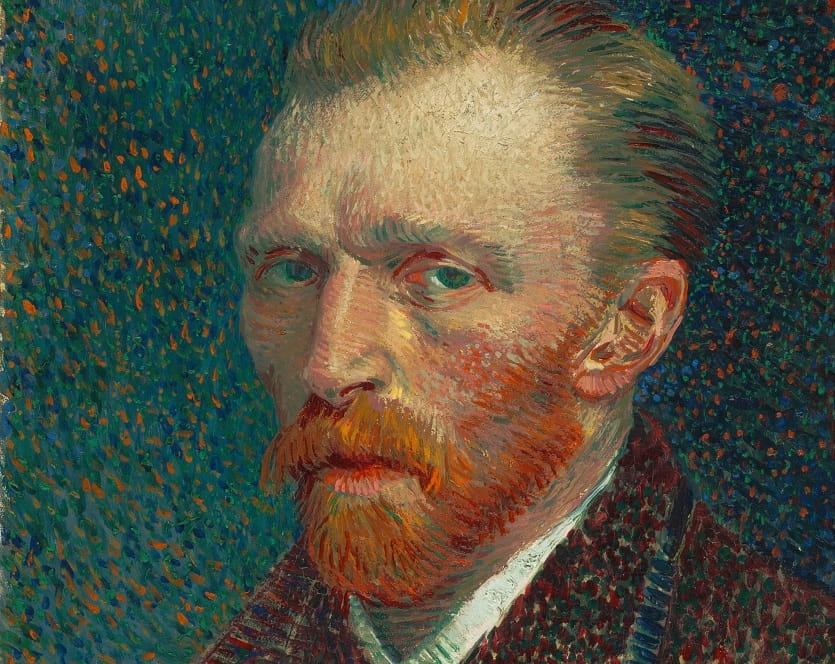
Vincent van Gogh, “Self-Portrait” (1887) / Google Art Project
The alternation between vivid oil paintings—primarily portraits and landscapes—and black-and-white photorealistic images allows the viewer to shift between the events of the investigation and the artist’s past. This dichotomous alternation of scenes also alludes to the characteristics of the shifting phases of bipolar disorder—depressive and manic. This immediately brings to mind the dichotomy of Van Gogh’s oeuvre as a whole—the somber palette of his Dutch period and the exuberant, manic riot of colors in his Provençal phase, where the color scheme takes on a unique character: black and white disappear, and bright colors blend together, creating a distinctive interplay of hues.
It is impossible to remain indifferent or not be captivated by the director’s ingenious idea of bringing the canvases to life. They are incorporated into the film as fragments that slowly come to life. And this movement itself undoubtedly becomes a full-fledged character in the film. As if emerging from the mist of the past, amid the silvery shimmer of broad brushstrokes, the image of a young mother suddenly appears in the light of the morning sun, lightly and effortlessly brushing a strand of hair from her eyes; then she turns her smiling face toward her child, and the child smiles back at her.
Through this movement of the canvases—this coming to life of nature that we see on screen—the idea is conveyed that Vincent may, after all, have gotten through to her. His attempt to revive his emotionally dead mother through his art has succeeded. And so, through the response of his admirers from around the world—albeit symbolically, across time and distance—that tender stir he so longed for in his life took place within his traumatized soul. Something, at last, had thawed.
I’d like to think of this film as a reflection of the unconscious desires not only of the crew and the director, but also of the unconscious of our entire society—a society that made possible not only the emergence of the crew and the film’s concept, but also the growth of a devoted audience capable of feeling and appreciating this incredibly tender stir of love.