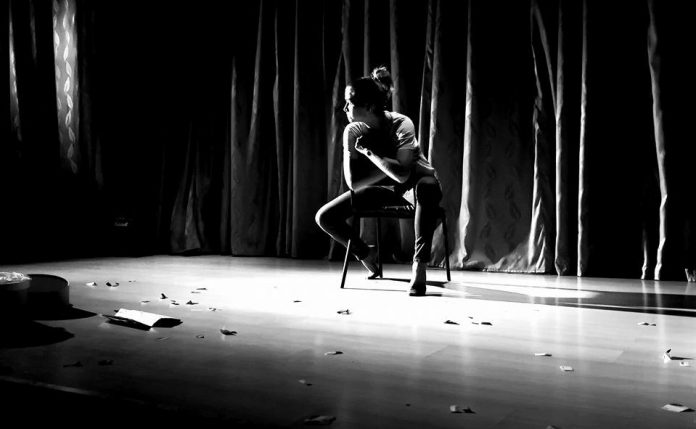
The Search for Identity in an Era of Change
The volatility of the modern world and its rapid transformations require psychological maturity and a willingness to answer the question “Who am I?” anew each time, without losing a sense of one’s own continuity, inner harmony, and stability.
The “Natasha’s Dream” project, born at the intersection of theater, coaching, and psychoanalysis, helps us understand that even in an era of change, we can dare to embark on a search for identity and succeed in it.
When we talk about theater today, it’s important to remember that we’re talking about theater in the age of Facebook, messaging apps, and people’s immersion in various forms of online interaction. During periods of self-isolation, these platforms are thriving, while the theater world—like many other offline formats—is in crisis.
But theater is the oldest prototype and the first version of that global “video game” we call life, and perhaps it is precisely through theater that we can determine today whether life will remain the same or will never be the same again. So, despite the distance—or perhaps because of it—there are plenty of stories seeking an audience, viewers eager to watch these stories, and actors dreaming of performing them on stages both large and small…
This raises some pressing questions: Where do we find the source of creativity? How do we sustain that creative wellspring? How do we truly be ourselves—rather than merely appear to be—and recognize in time who we truly are inside, even when we sometimes have to play a wide variety of roles in real life?
We explore these questions in a conversation with Natalya Mitkevich—a psychoanalytically oriented business coach, a psychologist by profession, and an actress at heart and on stage—who performed the one-woman show Natasha’s Dream (directed by Lada Selivanova), based on a play by the young Russian playwright Yaroslava Pulinovich.
Headology: “Natasha’s Dream” is a play about the fate of a dream. What does that fate seem like to you? Does Natasha lose her dream? Does she find it?
Natalia Mitkevich (NM): If we’re talking about my Natasha—the one inside me—then she returns to her dream, rediscovers it. I wouldn’t say that I ever lost that dream; no. Rather, it was biding its time.
I used to perform in the “Ecopolis” school theater and dream that when I grew up, I’d act in “serious plays.” That idea never left me; it lingered somewhere on the periphery of my consciousness. It was with me even as I was building my career in business; and when I was pursuing a second degree and establishing my coaching practice; and even when I devoted all my energy and time to raising my young son—the dream was with me.
Perhaps that’s why it rapidly became a reality as soon as it found a place—first in my heart, and then in my life. And also because my other roles seemed to nurture me and nudge me toward what I truly desired.
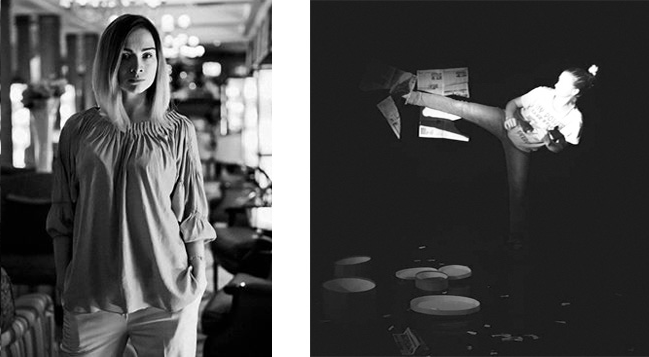
Headology: Well, what about your character—what happens to her dream?
NM: I suppose you’ll have to see the production to form your own opinion about the fate of my character’s dream and her clash with reality. I don’t want to reveal that secret prematurely.
That’s the beauty of theater: in theater, the audience—deprived of the ability to control the actors like puppets and to express feelings or even emotions through direct action, as is usually the case in life, well, okay—or in a video game—must face the uncertainty of anticipation and, in that anxious void, give birth within themselves to genuine, heartfelt reflection on such phenomena of life as dreams and reality, love and hate, life and its meaning.
This is well illustrated by the example of the interaction between a mother and her child. As the mother of a little boy, I know how important it is for both of us to endure the anxiety of the uncertainty caused by a brief separation, so that the child’s imagination can fill that void. This then allows him to take on the role of an active explorer and director of his own life. A son who “loses” his mother for a few hours while she is performing a play learns to use his imagination in her absence and, in my view, also “gains” a mother who is happier as a result of fulfilling her long-held dream.
As the father of child psychoanalysis, D.W. Winnicott, wrote, a mother must “entice the child with life,” infecting him with the desire to live. I would add: to create and to follow one’s dreams. I believe that I have definitely “infected him with a love of life,” and that this will, in time, help his own dream to be born and eventually come to fruition.
Headology: Could we say that by returning to the theater and following your dream, you’ve also reconnected with your inner child?
NM: In a special way. When I was a child, the “Ecopolis” studio was the place where I was ready to spend all my time. It nurtured my “theatrical” self.
Then I went to college, started working, and got caught up in the cycle of “I have to work, I have to succeed.” But sometimes the thought of theater would come back, even though I never actually did anything about it. The counterargument was always: “We’re serious adults. What kind of dream is that? We have to work!” Is it okay that I’m quoting lines from a play? That’s how it goes: you start staging something, and the characters’ words take deep root in your soul.
I took the first step two and a half years ago, when I decided to teach movement classes to schoolchildren—students at “Ecopolis.” And in the summer of 2018, I felt that my own desire to perform on stage was becoming too much of a “hot potato,” and I urgently needed to pull it out from behind my back and out of the world of my own dreams and fantasies to share it with the outside, very real world. It’s like stepping out of your video game into reality.
Director Lada Selivanova responded enthusiastically to my request; she opened up “Natasha’s Dream” to me. One day, sitting on the banks of the Volga and talking about our plans, we realized that we both had enough enthusiasm and drive right now to tame this emotionally charged, intensely powerful, and somewhat unconventional work. We decided to give not only my inner child a chance to find a dream, but also other “children”—those who are just learning to dream and those who would like to regain that ability.
I read the play in one sitting and decided to take the role. After all, what you truly need isn’t something you can choose. It just comes to you—that’s all.
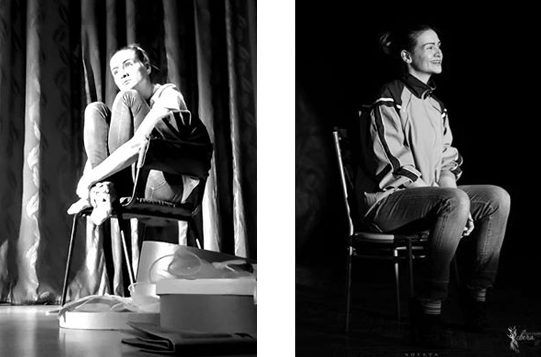
Headology: What can theater offer that other formats—not just in art, but in life—cannot?
NM: Theater is about the inner work of the soul, which both actors and audiences engage in. Other formats have their own value. Social media—those indispensable tools for work, communication, networking, and leisure—are also the main thieves of our most precious resource: time. That special time the Greeks called “kairos,” when you can be truly present with yourself, feeling deeply.
Social media voraciously devours our attention, shutting down our most fundamental human function—empathy. This ability to truly attune oneself to another’s state of mind, to feel and experience deep interpersonal connection, is inherent in human nature, and people will always strive to realize it.
But in the digital age, this aspiration, unfortunately, is becoming akin to the 20th-century dream of finding extraterrestrial civilizations. It is indeed possible to sincerely desire to experience such interpersonal interaction, while at the same time feeling a primal fear of discovering a symbolic “alien” within the unexplored universe of the Other’s soul.
Headology: Do you combine theater and creative group work in order to open up the inner cosmos for those people whose capacity for empathy has become somewhat lost in the web?
NM: I believe in that, but I in no way downplay the importance of the transformations taking place in the digital industry. Digitalization increases the efficiency of information processing and reduces communication time, but it is also harmful in that it allows a person to be in contact with the Other without offering anything in return in terms of genuine human emotion.
And if online forms of interaction prevail, I think this poses a danger in the form of a kind of social isolation and a decline in genuine, soul-to-soul connections. That’s why the time people now have available at work, thanks to technology, simply begs to be spent communicating with loved ones, engaging in creative pursuits, pursuing spiritual development, rejuvenation, and the realization of dreams—all the things that allow them to feel truly alive.
Headology: With the pandemic, most of the world has essentially shifted to an online model. Do you think this could lead to a loss of direct contact?
NM: Everything has changed now and will continue to change. I think it’s important for us not to stand still either; we’ll keep looking for new approaches and new formats. During the lockdown, theaters reached out to audiences online. But I think we need to strike a balance here, recognizing both the resources and the limitations.
Going online expands our reach and gives people who previously couldn’t access the arts—for example, due to distance from performance venues—the opportunity to experience them. At the same time, we must understand that the magic of that exchange of energy happens precisely in the theater. We’re just learning to make that happen across the vast distances that the online format imposes on us.
Headology: Both self-isolation and Natasha’s Dream call on everyone to look within themselves, to take a close look at their own dreams…
NM: Did you know that there have actually been many productions of “Natasha”? And each one resonates with the audience in its own way. The play has been staged not only in Omsk, the playwright’s hometown; audiences in the capital have likely seen the production as interpreted by the Praktika Theater…
I believe that every author has their own readers, and every director and actor has their own audience. And I hope our “Natasha” will also resonate deeply with someone.
I’ve noticed that, usually, if a work isn’t very well-known (say, it isn’t part of the school curriculum or hasn’t been adapted for the screen), then, of course, the audience doesn’t read it before the performance. In other words, many people, when they come to the theater, don’t even know what to expect.
But I believe that when choosing a particular play, the audience makes a choice intuitively—even, if you will, unconsciously—and, as a rule, very accurately. It’s as if their soul is guiding them toward what is needed at that moment. And I, too, have encountered this manifestation of the universal creative force.
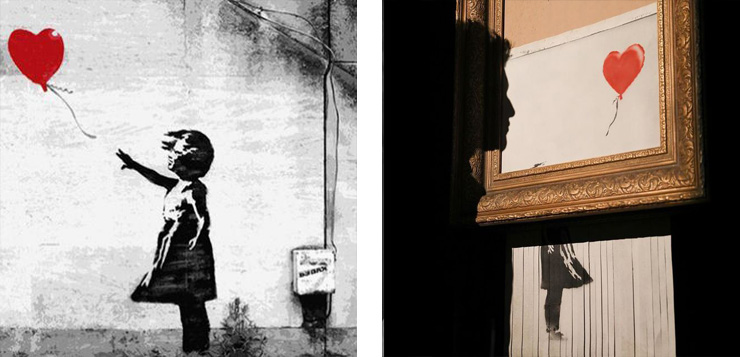
When the director and I were thinking about the visual design of the play, I used a photo of Banksy’s painting “Balloon” as an illustration. That was my Natasha. I made this choice a few weeks before that very painting was sold at Sotheby’s for $1 million, and at the moment of the sale, a shredder inside the frame activated and destroyed the painting.
When I found out about this, I was transfixed with awe at the realization of the profound parallels between my choice of illustration and the idea behind our play—namely, the activation in many of us of a self-destruction program at the very moment when the realization of a dream is closer than ever. Another coincidence? No, I guess we just got swept up in the flow.
Headology: How did the audience receive the performance?
NM: Overall, I think the response was warm, open, and emotional. It’s hard for me to talk about this, since I might be biased. The audience, however, said that the play makes you think, that “the room held its breath, afraid to miss a word, a gesture, or a facial expression,” and that it’s a touching story—a talented, powerful, and moving performance.
The audience isn’t just watching the actor perform; they’re living through this story alongside her…
Of course, I’m very pleased to hear feedback that, as an actress, I managed to convey the state of mind and image of a teenager, and that I touched the hearts of the audience.
After the premiere, I felt a special gratitude toward those discerning audience members who gave me insights on how I could continue to grow and refine my performance. I love honesty and the ability to speak openly. It’s about the authenticity of the connection between human souls.
My inner narcissus, of course, bent slightly under such a strong wind of feedback, but after all, any plant needs not only sun and water to grow, but also the rustling of the wind to make it stronger and more resilient. Isn’t that right? That’s why the work on fine-tuning the role continues for as long as the play runs.
It’s important to me that people leave the performance feeling, “You’ll be reflecting on everything that happened on stage for a few more days.”
Headology: Last year, the play took part in several theater festivals. How did the professional jury evaluate the production?
NM: I think this is one of those cases where our own feelings about what emerged during the creative process, the warm response from the audience, and the objective assessment by professionals all aligned.
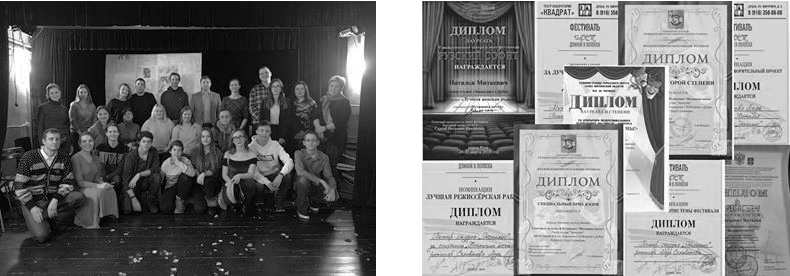
In 2019, we participated in five theater festivals with Natasha’s Dream. We brought home an award from each one—and sometimes more than one: winner of the “Ruzsky Sofit” festival in the categories “Best Female Role” and “Creative Collaboration Between Director and Actor”; winner of the All-Russian educational seminar-workshop “While the Candle Burns” in the category “Best Performance”; winner of the “Pushkin Theater” festival in the categories: “Best Production,” “Special Jury Prize for Best Performance”; Winner of the 7th Open Interregional Festival-Competition “Hello, It’s Us!” in the category: “Second-Place Winner”; Winner of the “A Bridge Half a Century Long” theater festival in the categories: “Best Direction,” “Best Charitable Project,” “Best Female Role,” and “Best Interpretation of the Festival’s Theme.”
And this is truly significant recognition. We are sincerely proud of it.
Headology: Which award do you like best?
NM: For me, the award for Best Performance (including Best Female Performance) is the most meaningful. For the director, I think it’s the award for Best Directing. And for both of us—the “Creative Duo of Director and Actor.” Although that’s just my guess; you’d have to ask the director to be sure.
Headology: Are there any specific moments in the heroine’s story that resonate with you?
NM: The starting point was the drama of a sixteen-year-old girl’s love. More precisely, her fantasies about love. I suppose many of us went through that in our youth.
When you think you’re in love, but then it turns out that it’s just an illusion. And only for you. But love is always a feeling and a joint effort for two people. You can’t love on your own. On your own, you can only fall in love.
“Natasha’s Dream” is a subtle psychological theatrical experiment exploring the search for one’s inner self, in an attempt to understand how different sub-personalities coexist within a single person.
This is a play that, I’m sure, will capture your attention, allowing you to pause and reflect. It will pull you out of your usual comfort zone—perhaps even from social media itself. It will reveal a different reality—one that isn’t virtual. And it will raise questions about what is reality and what is a dream.
Headology: The premiere of a play is its culmination. Before that comes the preparation phase, and after the premiere, the play’s theatrical journey continues. What do you value about each of these stages?
NM: I’d like to compare staging a play to the birth of a child. The premiere is the moment of birth. Before that, the play goes through all the stages—from nurturing the idea in your mind, the “pregnancy,” the moment of creative conception, to life in the womb—when you nourish the inner image of the character with your thoughts and feelings until, in fact, the birth.
And all this time, you’re very anxious, thinking about how it’s all going to turn out—in short, moms will understand me. There are so many emotions, and you have to cope with them somehow. There’s even a term for it: “containing emotions”—enduring them and giving them meaning.
A premiere, like childbirth, is a test of resilience; you need to concentrate as much as possible and carry out what nature has intended. Before that, and at the moment of the premiere, you don’t really spend time thinking about why you’re going through this process. There’s only one goal—to bring it to life.
So, yes, after the premiere, the play’s life begins. It has to grow stronger, find its footing, announce itself to the world, and find support from others—audiences, followers, and critics.
And I believe a play should be performed on stage until it matures, reaching adulthood—perfection—as long as it holds the attention of those who create it and those who watch it. And then it’s time to let the play go, to prepare for a new creative “pregnancy”…
Headology: How did the preparation process go?
NM: First of all, we analyzed the play and tried to understand it. What kind of heroine is she, and what is her personality? What is the overarching theme of the work? What should the audience be thinking about? What will they take away from the performance?
With each reading, the director and I discovered something new in the text; new meanings emerged during rehearsals. And then it became clear why different directors, staging what appears to be the same play, end up with completely different productions; and why different actors, playing what seems to be the same role, present such different characters to the audience.
Headology: Was it difficult to get into character?
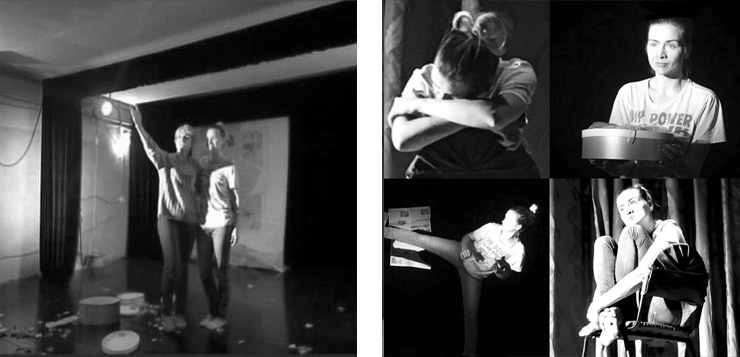
NM: It was difficult—and did I actually succeed? My character is a 16-year-old girl from an orphanage. It’s not that easy to play. To really get into her skin, to think, reason, feel, speak, and move like her.
Okay, I could imagine how teenagers look and act these days… But what about someone who grew up in an orphanage? Still, it’s an interesting experience—stepping beyond the boundaries of how I usually understand myself. I was especially pleased when one of the festival jury members genuinely couldn’t believe that the “girl” was over 30.
At first, it felt awkward to rehearse, standing one-on-one with the director. We’d read through it, discuss it—then “act.” But how exactly do you act? For me, the solution was to follow my body’s lead. I think the production turned out to be very intuitive.
As you work, of course, you get into the creative flow. Ideas come naturally, energy surges, and excitement kicks in: “Hey, let’s try it this way! And here, let’s do this!” and so on. It’s incomparable—pure bliss.
You get pleasure from the process itself and forget about the need for a result. It’s a good thing we had a deadline in the form of the premiere date. Otherwise, we would have just kept rehearsing forever.
Headology: How did you get through particularly tough moments during the production?
NM: Of course, I hit a wall… About two weeks before the premiere. During a run-through, when we were setting up the lighting, and I was standing in the middle of the stage, I realized I couldn’t remember a thing. Absolutely nothing. The text is born somewhere on the border between memory and panicked improvisation. I realize that beyond that point is a cliff… I’m already tumbling down it… it feels like I’m spouting nonsense… But then the director said to me, “I don’t believe it!” And I’m thinking, I guess that “I don’t believe it!” is a good thing, right? It means the play is already “inside” me, it means the text is flowing on its own. At a moment like that, it’s best to relax and trust the process. The body remembers everything; it will guide you in a difficult moment.
Headology: Have there been any mishaps during performances?
NM: They happen to all actors. Probably the two “funniest” ones were… During one festival, 10 minutes into the show, the metal leg of the only chair on stage—the one I’m sitting on—broke off and rolled backstage with a crash… And you have to stay balanced on three out of four legs. Thanks to yoga and good physical conditioning, I managed to hold on for an hour. Some people even thought it was a clever directorial move.
And then, one time, a film crew came to shoot a TV version of the play. So—also at the beginning of the performance—it seemed to me that I’d forgotten my lines and mixed up the staging! And that means the entire narrative logic is disrupted, that it’s unclear when new characters will appear, and that I have absolutely no idea where I am in the script or what will happen if I go any further.
And there you are, standing under the spotlights, looking out at the audience, at the camera’s red light, and realizing that the only thing you can do is smile, take a bow, and say, “Thank you, everyone. All dismissed. Curtain.”
I don’t know what gave me the strength not to stop and walk off the stage, but it was probably that same self-confidence. In the end, it turned out that I hadn’t messed anything up, that even the director hadn’t noticed a thing, and that everything went perfectly. But that fear of a deadlock situation inside me stayed with me for a long time.
Although now I look back on both of these episodes with a smile.
Headology: How did the working relationship between actress and director develop?
NM: Lada Selivanova is the ideal director for me. She’s a sensitive guide with a bell, not a sculptor-craftsman with a chisel. She doesn’t say, “Do it this way here,” or “Do it that way there.” It’s as if we’re sailing together in the same boat down an uncharted river, and she, like an experienced helmswoman, hints: “Over there, on the right, it might be deep,” or “There’s a strong current here—you should row a little harder.”
For me, this kind of creative partnership is pure joy. Although sometimes I want to ask her: “So what exactly should I do?” But she’s right. You don’t need instructions; you have to help a person create their own role from within. And ring the bell at the right moment when you start to lose your way around the turns.
Headology: What happens after the performance? How do you interact with the audience?
NM: The overarching goal of the performance is to draw the audience’s attention to important themes that are sometimes pushed out of our consciousness. To bring these themes to the surface immediately after the performance, once I’ve stepped out of the role of Natasha, I lead a “Workshop of Meanings” as a psychologist and facilitator of a reflective group.
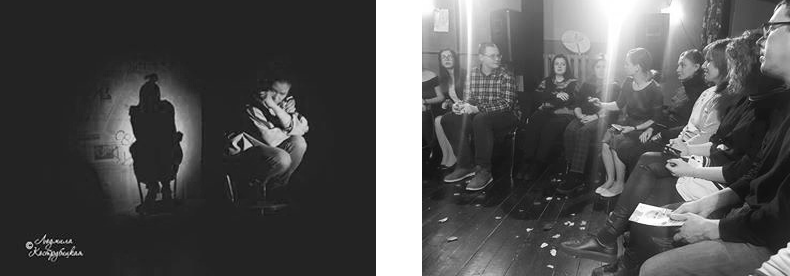
This is a space where we gently explore and discuss the feelings that arose during and after the performance, reflect on how various themes raised in the play resonate within us, and share our imaginings about the characters’ fates.
This format of in-depth discussion immediately following the performance has a harmonizing, therapeutic effect (after what is objectively an emotionally taxing play), increases self-awareness, and draws the audience toward important inner themes, often leading to questions about the inner need to help others.
At some point, teachers began bringing high school and college students to our performances and workshops so they could use art as a starting point for conversations about important human issues. And this is especially necessary now for the younger generation, which has retreated into an online reality—or, more accurately, an unreality.
And I see these—albeit small but significant—internal transformations taking place—in both teenagers and adults—over the course of a few hours spent at the performance and the workshop. Perhaps that is what matters most.
Headology: Did a formula for turning dreams into reality ultimately emerge?
NM: The resulting performance is a question posed—both to the audience and to society. How do you live when no one is afraid for you? Where does that fine line between dream and illusion lie? Where do our childhood traumas live within us, shaping our lives and who we are? Can the system nurture a person without crushing them? Is love about taking or giving? All of this provides rich food for thought.
And the surest way to turn a dream into reality is to allow yourself to dream in spite of fears and anxieties. To have the ability to hear the voice of the creative spirit hidden deep within every person. To open your heart and mind in order to let into your life what you truly desire—not what society, your status (noblesse oblige), or your “ego” demands of you, but precisely what you’ve been dreaming of, usually since childhood.
How often do we hear “that’s pointless,” “you can’t make money doing that,” “that’s not serious”! It is precisely these “not serious” remarks that later seriously trap a person in a job they dislike or in a social circle that doesn’t resonate with their spirit.
So, listen to the quiet voice of your inner child, remember what you loved most as a child, and ask yourself what would bring you joy right now—that’s what will help make your dream a reality. And don’t be afraid to take action. By revealing your true self—not just the successful side, but also the vulnerable side, or by discovering different desires within yourself. When this happens, you’re bound to find support from others.
Headology: Do you always find people who need your support?
NM: Right from the very beginning, I had an inner understanding that the “Spectacle-Workshop” project would be a nonprofit initiative aimed at helping children.
After every performance, as a trustee and volunteer for the “Sheredar” Charitable Foundation—which provides rehabilitation for children who have survived cancer—I ask the audience to help the children in the Foundation’s care. Over the course of a year of performances, we’ve raised enough funds to provide rehabilitation for two children. I don’t know if that’s a lot or a little. But the ocean is made up of drops.
The children under the Foundation’s care also have their own childhood dreams, which—due to the illnesses they’ve endured—are much harder for them to realize than for most of their peers. And “Sheredar” helps them believe in themselves and open up to the world. I believe that with God’s help and our collective support, there will be more smiles on these children’s faces.
This is also Natasha’s Dream.
The interview was conducted by S.V. Belukhina. Read more…
Reposting is welcome provided the interviewer’s name and source (headology.org) are credited.